Estimated reading time: 6 minutes
Walk Like a King. They say, “The king is half-god. Walk like it.”
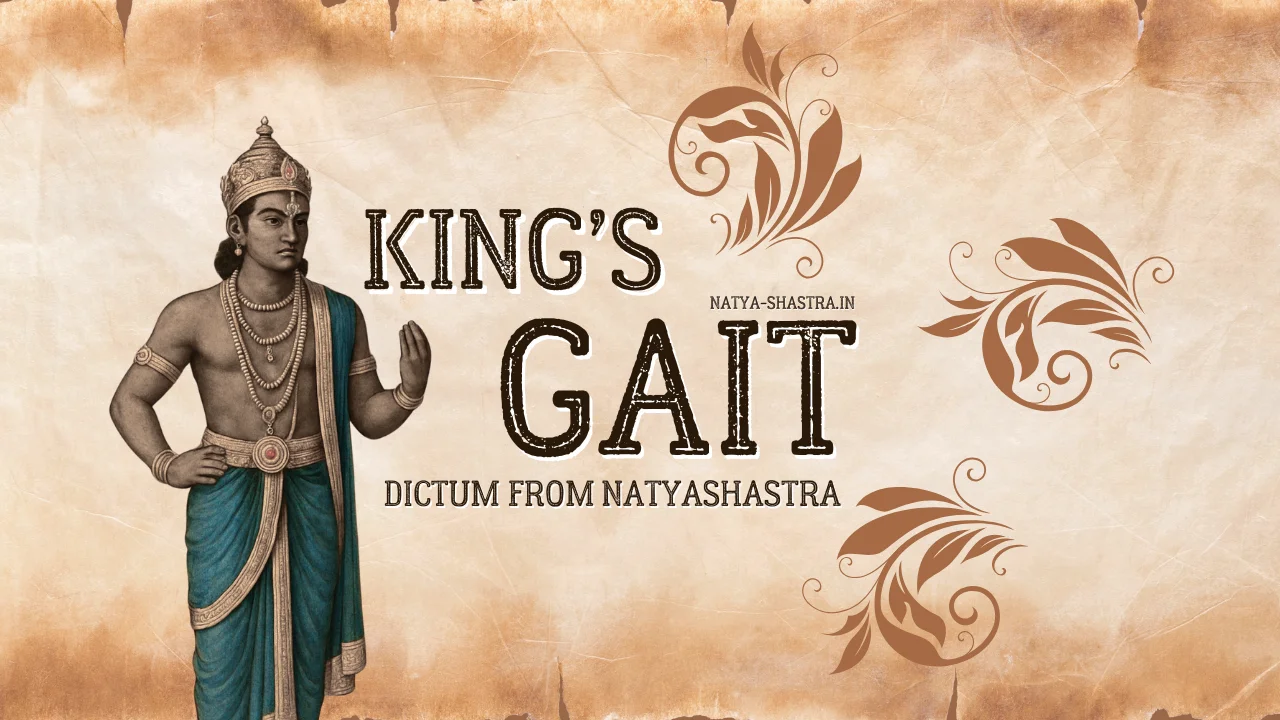
In Natyashastra and in reality, kings command attention with every step. Their gait is curated. Choreographed. A fusion of theatre and cosmic energy. And it’s part of what makes the stage sacred.
Let’s break down how to do the King’s Gait as detailed in the Natyashastra. Don’t this of it as an abstract idea, but as a practical, physical method you can feel in your bones.

What is “King’s Gait” in Natyashastra?
In Samskruta, gait is “gati“, गति, the act of moving. In performance, it’s the kinetic fingerprint of a character. The King’s Gait is a type of prasāra (प्रसार) or “extension of movement.” Natyashastra identifies three classes of characters:
- Divine (daiva).
- Semi-divine (divya-mānava): kings
- Human (mānava)
Why should kings walk like gods? Because in Vedic texts, they’re part god. They were born from the limbs of deities. So when kings walk on stage, they soar.
Psst: do you know how Brahma calmed the nerves of daityas? – You should know this story.
Here’s the root of it, directly from the Natyashastra.

यदा मनुष्या राजानस्तेषां देवगतिः कथम् ।
अत्रोच्यते कथं नैषा गती राज्ञां भविष्यति ॥ २५॥
yadā manuṣyā rājānasteṣāṃ devagatiḥ katham |
atrocyate kathaṃ naiṣā gatī rājñāṃ bhaviṣyati || 25||
Meaning:
When kings are human beings, how can they carry the gait of the gods? Here it is said, this gait (divine gait) does not naturally belong to kings.

इह प्रकृतयो दिव्या दिव्यमानुष्य एव च ।
मानुष्य इति विज्ञेया नाट्यनृत्तक्रियां प्रति ॥ २६॥
iha prakṛtayo divyā divyamānuṣya eva ca |
mānuṣya iti vijñeyā nāṭyanṛttakriyāṃ prati || 26||
Meaning:
In this context, there are divine and divine-human natures, as well as purely human ones. These are to be understood from a dramatic and dance actions POV.

देवानां प्रकृतिर्दिव्या राज्ञां वै दिव्यमानुषी ।
या त्वन्या लोकविदिता मानुषी सा प्रकीर्तिता ॥ २७॥
devānāṃ prakṛtirdivyā rājñāṃ vai divyamānuṣī |
yā tvanyā lokaviditā mānuṣī sā prakīrtitā || 27||
Meaning:
The nature (gait) of the gods is called divine (divyā). For kings, it is divine-human (divyamānuṣī). And the other type, which is commonly seen in the world, is known as human (mānuṣī).
So, walk like a king!
We are here, follow us.
How To Practice King’s Gait?
Foundation
The King’s Gait is all about stability, grace, and presence. Think: majestic but measured. Assertive but not aggressive.
Key markers:
- Feet: Firm placement. No dragging. No bouncing.
- Knees: Slightly bent. Fluid, never stiff.
- Hips: Minimal sway.
- Chest: Lifted. Proud. Never puffed.
- Arms: Resting naturally or gesturing deliberately. No flailing.
- Neck & Chin: Upright. Eyes look front. Commanding, never searching.
Sequence
- Start with the right foot. – Always. Symbolically auspicious and grounded.
- Step with even rhythm. – No rush. This is controlled power.
- Pause before pivoting. – Don’t swivel. Turn with intention.
- Keep shoulders aligned. – This maintains the frame.
Mudra and Bhava Pairings
- Use kataka-mukha (कटकमुख) mudrā when gesturing to the crowd
- Use ardhachandra (अर्धचंद्र) when indicating direction
- Maintain āशाली (आशाली) bhāva – serenity with authority

Get featured on this blog?
Share your videos and images of you performing classical dance!
We’d love to showcase your talent and passion for classical dance with the world. (with proper credits)
What the Gait Communicates?
King’s Gait/Gati signals:
- Power without brute force.
- Control without stiffness.
- Balance between heaven and earth.
The king’s steps should tell the audience: This character rules not only the land but the space between beats.
Examples on Stage
- In Koodiyattam, the character of Bali uses the King’s Gait before the war scene.
- In Kathakali, kings enter with exaggerated rājagati while drums mark each footfall.
- Indian Classical Dance Bharatanatyam. Here Lord Rama is performed with a modified royal gait, upright and measured.
Explore Samyuta and Asamyuta Hastas
Gait Deviations
The Natyashastra allows variation when the king is:
- In haste (vega): steps shorten and quicken
- In anger (krodha): heel-first stomping
- And, in madness (unmāda): broken rhythm, unpredictable weight shifts
But never lose the spine. Even chaos has grammar.
Scholarly References
- Bharata Muni‘s Natyashastra, Chapter 10 (vāhana-prayoga and gati)
- Abhinayadarpana by Nandikeshvara (for comparative animal-based gatis)
- Dasarupaka by Dhananjaya (contextualisation of roles and movement)
- ViṣŇudharmottarapurāṇa, Trtiyakhanda (encyclopedic discussion of artistic elements)
- Kapila Vatsyayan: “Classical Indian Dance in Literature and the Arts”
Frequently Asked Questions
Because kings are seen as part human, part divine. Their gait reflects this. Strong like men, graceful like gods.
Dancers walk with even steps, upright posture, and mirrored arm movements. It’s slow, steady, and full of presence.
The royal gait shows power and control. The divine gait feels light, flowing, and celestial.
Anyone can learn it with training. But it’s mainly used for portraying kings, heroes, or rulers.
People think it’s exaggerated or hard. It’s neither. It’s precise, grounded, and follows a clear rhythm.
Share the article
Conclusion
King’s Gait is how they arrive.
Every step is a signal. Every pause, a punctuation. Dance is not mimicry. It’s manifestation. When you move like a king, the stage bends to your will.
So straighten your spine. Let the rhythm guide you. Walk like the gods are watching.
Because in Natyashastra, they are. Walk like a king.
About Natya-Shastra.in
At Natya-Shastra.in, our mission is to serve as a gateway to the illustrious world of the NāṭyaŚāstra. We offer insights, resources, and a platform to delve deeper into the nuances of Indian performing arts.
Also, we aim to bring forth the richness of this ancient text. We try to shed light on the profound wisdom it holds and its everlasting influence on various artistic traditions.
We are here, follow us.
Disclaimer:
Affiliate Links: Some links earn us a commission (at no cost to you). We only recommend helpful products.
NatyaShastra Glossary: Head over to the Natyashastra Glossary page to know the meaning behind Sanskrit terms used in the articles.
Images & Videos: Representational only, not exact depictions.
Knowledge Source & References: Inspired by ancient Natyashastra scriptures, open to interpretation.
Disclaimer: Educational only, not professional advice. Consult a qualified expert for specific needs.
Offer Your Expertise