Movement Theory – Gati, Chari, and Mandala in the Natyashastra
Last updated:
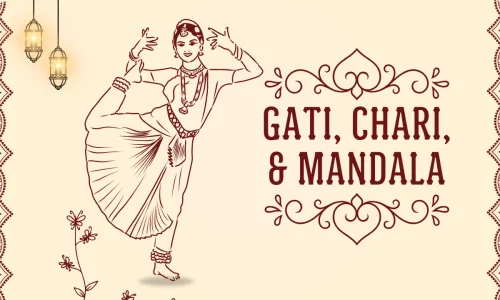
Movement theory (Gati, Chari, Mandala) in the Natyashastra is a language.
Before a word is spoken, before a gesture is made, the way a character enters and occupies space tells the audience everything they need to know. Is this person a king or a beggar? Are they afraid or certain? Do they carry the weight of grief or the lift of joy?

This course works through the complete movement vocabulary of the Natyashastra – from Gati (gait), the fundamental walking patterns that carry emotion through space, through Chari (the dynamic movement unit), Mandala (the spatial formation built from Charis), Angahara (the structured movement sequence), Recaka (the subtle refinements), and Pindibandha (group choreographic formations).
Every concept is grounded in the Natyashastra’s own chapters and explained with enough practical detail that a dancer, teacher, or researcher can use it directly.
What you will learn:
- What Gati is and how it carries Rasa through walking alone
- All nine sentiment-based gaits and their emotional qualities
- Gaits for professions, animals, women, and special states
- Sitting, standing, and lying-down postures as movement vocabulary
- What a Chari is and how it differs from a step or footwork sequence
- The 32 Charis and how they are classified
- What Mandalas are and how they are built from Charis
- Earthly Mandalas – grounded spatial patterns
- Aerial Mandalas – the 10 athletic flight combinations
- Angaharas – the structured movement sequences of classical dance
- Recaka – subtle nuance movements and their role in refinement
- Pindibandha – ancient group choreographic technique
Who this is for: Students of Bharatanatyam, Kathak, Odissi, Kuchipudi, and all classical Indian dance forms. Theatre practitioners, researchers, and dance teachers. Anyone who wants to understand why movement in Indian classical arts looks and feels the way it does.
Prerequisites: None. Familiarity with Rasa Theory course is helpful but not required.
Format: 21 lessons across 5 sections + Final Assessment. Each lesson includes a Did You Know fact, recommended reading, and a quiz.
Tags: Gati chari mandala, movement theory,
Institutional disclaimer
Please note: All courses and learning materials provided on Natya-Shastra.in are independent educational offerings. They are not affiliated with, authorized by, maintained, or sponsored by any official university, cultural institution, or examination authority. The content is created as a supplemental learning aid to deepen theoretical and practical understanding. Any references, images, or traditional diagrams are strictly intended as visual references to facilitate comprehension and memory retention.
Refund policy
Welcome to Natya-Shastra.in, where we make authentic knowledge of Indian performing arts accessible through interactive courses and digital learning tools. Please note that because our digital courses, downloadable materials, and recorded workshops grant immediate access upon purchase, all sales are generally final and non-refundable. Refunds are considered only in special cases, such as duplicate payments or unresolvable technical access issues on our end. Additionally, live events canceled at least 48 hours in advance are eligible for a refund or credit. For full details on our policies, subscriptions, or assistance with an issue, please view our complete Refund Policy or reach out to us at natyashastra7[at]gmail[dot]com.
Other related courses
Author
Curriculum
- 5 Sections
- 21 Lessons
- 4 Weeks
- Gati – Walking as Performance14
- 1.1Lesson 1: What is Gati? Movement, Intention, and Space15 Minutes
- 1.2Lesson 1: What is Gati? Movement, Intention, and Space (Quiz)10 Minutes3 Questions
- 1.3Lesson 2: Royal Gait – Walking Like a King15 Minutes
- 1.4Lesson 2: Royal Gait – Walking Like a King (Quiz)10 Minutes3 Questions
- 1.5Lesson 3: Sringara Gati – The Erotic Gait15 Minutes
- 1.6Lesson 3: Sringara Gati – The Erotic Gait (Quiz)10 Minutes3 Questions
- 1.7Lesson 4: Veera Gati – The Heroic Gait15 Minutes
- 1.8Lesson 4: Veera Gati – The Heroic Gait (Quiz)10 Minutes3 Questions
- 1.9Lesson 5: Raudra Gati – The Terrible Gait15 Minutes
- 1.10Lesson 5: Raudra Gati – The Terrible Gait (Quiz)10 Minutes3 Questions
- 1.11Lesson 6: Karuna Gati – The Pathetic Gait15 Minutes
- 1.12Lesson 6: Karuna Gati – The Pathetic Gait (Quiz)10 Minutes3 Questions
- 1.13Lesson 7: Bhayanaka, Bibhatsa, Hasya, and Adbhuta Gaits15 Minutes
- 1.14Lesson 7: Bhayanaka, Bibhatsa, Hasya, and Adbhuta Gaits (Quiz)10 Minutes3 Questions
- Postures and Character-Specific Gaits10
- 2.1Lesson 8: Gaits of Professions15 Minutes
- 2.2Lesson 8: Gaits of Professions (Quiz)10 Minutes3 Questions
- 2.3Lesson 9: Gaits of Animals15 Minutes
- 2.4Lesson 9: Gaits of Animals (Quiz)10 Minutes3 Questions
- 2.5Lesson 10: Walking Postures of Women15 Minutes
- 2.6Lesson 10: Walking Postures of Women (Quiz)10 Minutes3 Questions
- 2.7Lesson 11: Sitting Postures15 Minutes
- 2.8Lesson 11: Sitting Postures (Quiz)10 Minutes3 Questions
- 2.9Lesson 12: Lying-Down (Shayana) Postures15 Minutes
- 2.10Lesson 12: Lying-Down (Shayana) Postures (Quiz)10 Minutes3 Questions
- Chari – The Dynamic Movement Unit4
- Mandala, Angahara, Recaka, and Pindibandha14
- 4.1Lesson 15: Mandalas – Movement Through Space15 Minutes
- 4.2Lesson 15: Mandalas – Movement Through Space (Quiz)10 Minutes3 Questions
- 4.3Lesson 16: Earthly Mandalas – Bhumi Mandalas15 Minutes
- 4.4Lesson 16: Earthly Mandalas – Bhumi Mandalas (Quiz)10 Minutes3 Questions
- 4.5Lesson 17: Aerial Mandalas – 10 Athletic Flight Combinations15 Minutes
- 4.6Lesson 17: Aerial Mandalas – 10 Athletic Flight Combinations (Quiz)10 Minutes3 Questions
- 4.7Lesson 18: Angaharas – The Building Blocks of Classical Dance15 Minutes
- 4.8Lesson 18: Angaharas – The Building Blocks of Classical Dance (Quiz)10 Minutes3 Questions
- 4.9Lesson 19: Recaka – The Art of Subtle Movement15 Minutes
- 4.10Lesson 19: Recaka – The Art of Subtle Movement (Quiz)10 Minutes3 Questions
- 4.11Lesson 20: Pada Bhedas – Five Foot Positions15 Minutes
- 4.12Lesson 20: Pada Bhedas – Five Foot Positions (Quiz)10 Minutes3 Questions
- 4.13Lesson 21: Pindibandha – Ancient Group Dance Technique15 Minutes
- 4.14Lesson 21: Pindibandha – Ancient Group Dance Technique (Quiz)10 Minutes3 Questions
- Assessment1
Instructor

NatyaShastra Editorial is the research and writing team behind Natya-Shastra.in, India’s dedicated platform for studying Bharata Muni’s ancient treatise on performing arts.
The editorial work covers the full breadth of the Natyashastra: Dasarupakas, Rasa theory, Abhinaya, Karanas, Gati, Sanskrit prosody, and stagecraft. Every article is grounded in the primary Sanskrit text and written to make this knowledge accessible to dancers, scholars, theatre practitioners, and serious students of Indian classical arts.
Natya-Shastra.in also develops free interactive tools, including the Shloka Analyzer, Karana Identifier, and Rasa Detector, to help learners engage directly with the Shastra rather than just reading about it.
The platform hosts a growing community at r/Natyashastra and welcomes contributions from artists and researchers through its guest post and video submission programme.