Estimated reading time: 9 minutes
Stage Seating! After being part of Sanskrit drama for over fifteen years, I’ve learned something important. Audiences notice everything. They especially notice when something feels “off.”
But, one of the most common mistakes I see involves stage seating arrangements. Directors often place characters wherever looks visually appealing. Unfortunately, they don’t realize they’re breaking centuries-old theatrical grammar.
The truth is simple. In Sanskrit theatre, where your character sits matters as much as what they say. My teacher always reminded me this.

Why I Started Paying Attention to Seats?
Early in my training, I learned this lesson the hard way. I was performing as King in a production. During rehearsals, I casually sat on an ornate cushion that looked comfortable. Meanwhile, the actor playing my minister took the wooden throne upstage.
My acharya stopped the rehearsal immediately. She called me forward with a stern look. “Do you see what you have done?” she asked. I looked around, confused. The blocking seemed fine to me.
“You have made yourself lower than your minister,” she explained patiently. “In the audience’s eyes, he now holds the power. You are seeking his approval.” I felt my face flush with embarrassment.
That moment changed everything for me. My teacher made me understand something crucial. The Natyashastra’s seating prescriptions were practical tools that shaped the audience’s perception instantly.
From that day forward, I never sat anywhere without thinking first.
We are here, follow us.
What the Natyashastra Actually Says About Seats
Bharata’s Natyashastra dedicates significant attention to seating arrangements. The text distinguishes between two primary contexts:

स्त्रीणां च पुरुषाणां च बाह्यश्चाभ्यन्तरस्तथा ।
आभ्यन्तरस्तु नृपतेर्बाह्यो बाह्यगतस्य च ॥ २१४॥
strīṇāṃ ca puruṣāṇāṃ ca bāhyaścābhyantarastathā |
ābhyantarastu nṛpater bāhyo bāhyagatasya ca || 214 ||
Meaning:
There are external (bāhya) and internal (ābhyantara) manners (of movement, behavior, or demeanor). For a king, the internal type (ābhyantara) is appropriate. And for one who moves among the people (bāhyagata), the external type (bāhya) is suitable.
- Bāhya (Public Settings): Court assemblies, military councils, public audiences.
- Ābhyantara (Private Settings): Royal chambers, inner apartments, intimate gatherings.
When you’re blocking scenes, this distinction helps you create authentic stage seating that feels historically accurate to your audience.
The Male Hierarchy
1. Kings and Gods: The Lion-Seat (Siṃhāsana)
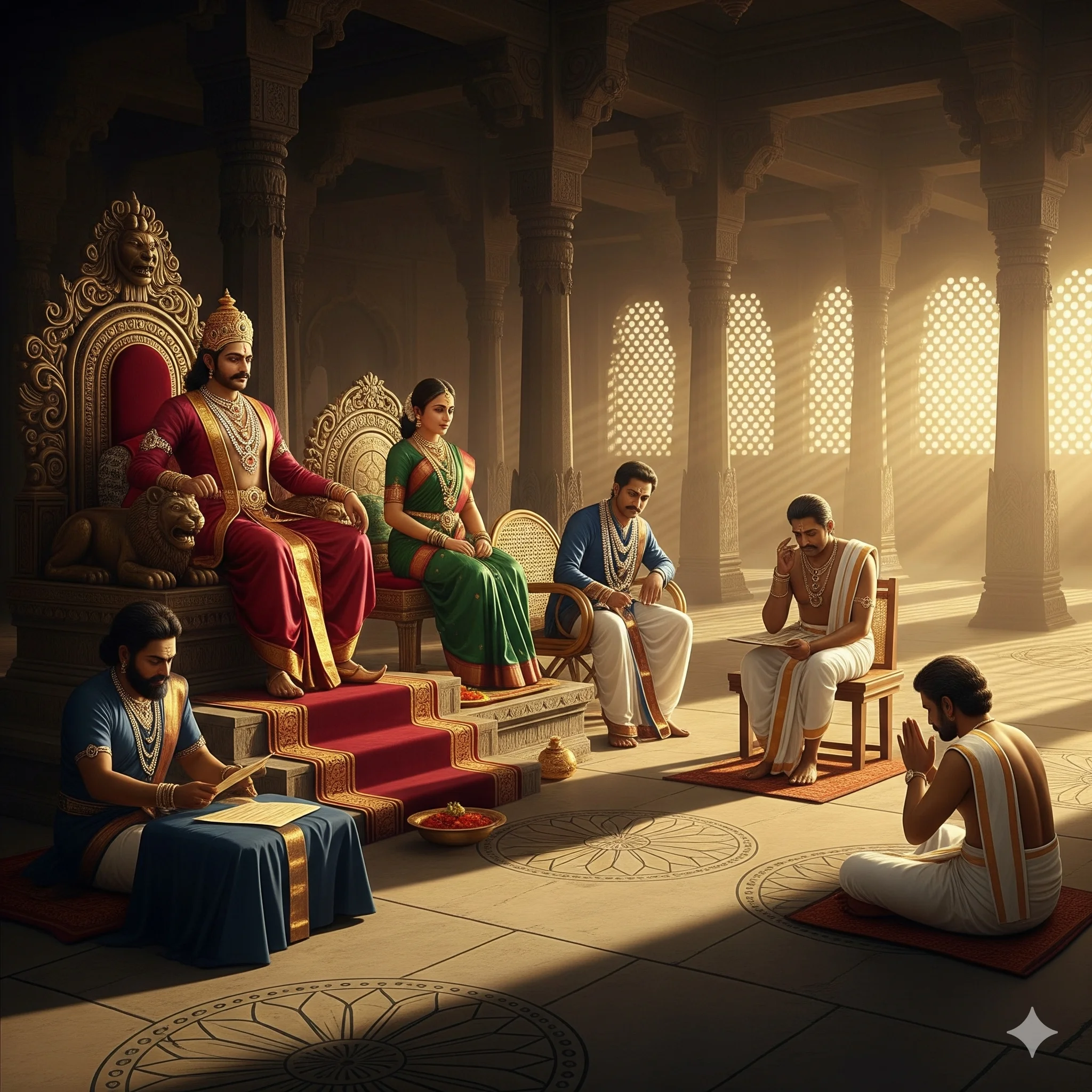
The lion-seat shows ultimate authority. Even a simple high-backed chair transforms into a proper throne. You simply drape it with rich fabric. Then position it prominently upstage.
It is all about elevation. Physical height instantly communicates power to the audience.
Practical staging tip: Have your king approach the throne deliberately. I often use the Veera Gati (heroic gait) here. This means slow, measured steps. Consequently, you build anticipation before the character even speaks.
2. Ministers and Priests: The Cane-Seat (Vetra-āsana)
These characters get functional, unadorned seats. I typically use simple wooden stools or benches. The message is clear. These are serious, dutiful people. Furthermore, they focus on dharma rather than display.

देवानां नृपतीनां च दद्यात् सिंहासनं द्विजः ।
पुरोधसाममात्यानां भवेद्वेत्रासनं तथा ॥ २१५॥
devānāṃ nṛpatīnāṃ ca dadyāt siṃhāsanaṃ dvijaḥ |
purodhasām amātyānāṃ bhaved vetra-āsanaṃ tathā || 215 ||
Meaning:
Deities (devāḥ) and kings (nṛpatayaḥ) should be given a siṃhāsana (lion-throne, a high and majestic seat). Priests (purodhas) and ministers (amātya) should be given a vetrāsana (a seat made of cane or a simpler official chair).
3. Crown Princes: The Muṇḍā-Seat
This low, sturdy seat suggests readiness for action. In practice, I use a simple wooden plank or low stool. The prince should sit with good posture. He appears poised for movement. So, he shows both respect for authority and personal strength.
4. Brahmins: The Wooden Seat (Paṭṭa-āsana)
Plain wood works best. Nothing fancy is needed. Brahmins sit cross-legged directly on this flat surface. As a result, they embody the austerity and learning their characters represent.

मुण्डासनं च दातव्यं सेनानीयुवराजयोः ।
काष्ठासनं द्विजातीनां कुमाराणां कुथासनम् ॥ २१६॥
muṇḍāsanaṃ ca dātavyaṃ senānī-yuvarājayoḥ |
kāṣṭhāsanaṃ dvijātīnāṃ kumārāṇāṃ kuthāsanam || 216 ||
Meaning:
A muṇḍāsana (a plain, possibly low or unadorned seat) should be assigned to the commander-in-chief (senānī) and the crown prince (yuvarāja). kāṣṭhāsana (wooden seat) is to be given to Brahmins (dvijātis). And a kuthāsana (a coarse or simple stool) is appropriate for princes or young nobles (kumāras).

Get featured on this blog?
Share your videos and images of you performing classical dance!
We’d love to showcase your talent and passion for classical dance with the world. (with proper credits)
Female Characters
The women’s seating arrangements mirror the male hierarchy. But, there are important distinctions:

सिंहासनं तु राज्ञीनां देवीनां मुण्डमासनम् ।
पुरोधोऽमात्यपत्नीनां दद्याद्वेत्रासनं तथा ॥ २१८॥
siṃhāsanaṃ tu rājñīnāṃ devīnāṃ muṇḍamāsanam |
purodho-‘mātyapatnīnāṃ dadyād-vetrāsanaṃ tathā || 218 ||
Meaning:
A siṃhāsana (lion-throne) should be provided for queens. A muṇḍamāsana (plain seat) is appropriate for royal ladies or chief consorts of high standing (devīs). And a vetrāsana (bamboo or cane seat) should be given to the wives of priests (purohitas) and ministers (amātyas).
Chief Queen: Gets her own lion-seat. Position it beside but slightly lower than the king’s throne. This simple height difference communicates her high status. At the same time, it maintains clear hierarchy.
Royal Women: Various ranks of wooden seats work well. Arrange them in careful order around the queen’s position.
Ministers’ Wives: Simple cane seats match their husbands’ practical approach.
Servants and Attendants: They stay closest to the ground. This emphasizes their service role.
Explore Samyuta and Asamyuta Hastas
What I’ve Learned from Staging These Rules
When I block a court scene now, I think differently. I create a “geography of power” on stage. The king’s throne sits center-upstage. Ministers arrange stage right on their cane seats. Meanwhile, the prince takes his position stage left.
This triangle creates natural sight lines. Moreover, it instantly communicates relationships to the audience.
Practical Challenges and Solutions
Modern theatre spaces don’t always accommodate traditional stage seating arrangements. But, we’ve to adapt. I focus on relative heights and positioning rather than exact seat types.
A draped folding chair can serve as a lion-seat. You simply need to elevate and position it properly. The key is maintaining the hierarchical relationships. These are what the text prescribes.
Want To Learn About Gaits?
- Gati (Gait): Unique Lessons From Natyashastra
- Walk Like a King: Royal Gait in Natyashastra
- Erotic Sentiment Gait: Śṛṅgāra Gati In Natyashastra
- Terrible Sentiment Gait: Raudra Gati In Natyashastra
- Heroic Sentiment Gait (Vīra Gati): A Hero’s Walk
- Walking Postures of Women in Natyashastra
Common Mistakes I See (and Made Myself)
- Treating all seats as equal: Every cushion, chair, and mat carries meaning in Sanskrit drama.
- Ignoring the public/private distinction: Courtroom scenes need different seating logic. Private bedroom scenes follow different rules.
- Focusing only on comfort: Modern directors often prioritize actor comfort. But, dramatic authenticity matters more.
- Missing the bigger picture: Seating works together with other elements. These include gait, gesture, and costume. Together, they create complete character presentations.
Frequently Asked Questions
Yes. Focus on relative heights and positioning rather than exact seat types. A draped folding chair can work as a lion-seat if elevated properly.
You risk confusing the audience about character hierarchy. Wrong seating can make a king appear subordinate to his minister, breaking the dramatic logic.
These specific rules come from the Natyashastra and apply primarily to all Indian dramas. Some regional forms have their own variations.
Very important. Court scenes (bāhya) require formal hierarchy, while private scenes (ābhyantara) allow for more intimate, family-based arrangements.
Absolutely. Breaking seating protocol is a powerful storytelling way to show rebellion, social change, or character conflict. But it should be an intentional choice.
Share the article
Final Thoughts
After years of working with these texts, I’ve gained new perspective. I see the Natyashastra’s stage seating prescriptions as solutions. They address common staging problems. Furthermore, they give a tested framework for creating clear, meaningful stage pictures.
The next time you’re blocking a classical Indian play, spend time thinking. Consider where each character sits and why. Follow Bharata’s guidance. As a result, you’ll find your productions gain a layer of authenticity. This resonates with both traditional audiences and newcomers to Sanskrit drama.
When your stage seating arrangements support the story’s hierarchy, audiences feel it. They sense it even if they can’t articulate why.
Remember this important point. In classical theatre, every element serves the story. Even something as simple as a seat can become powerful. If you know how to use it.
About Natya-Shastra.in
At Natya-Shastra.in, our mission is to serve as a gateway to the illustrious world of the NāṭyaŚāstra. We offer insights, resources, and a platform to delve deeper into the nuances of Indian performing arts.
Also, we aim to bring forth the richness of this ancient text. We try to shed light on the profound wisdom it holds and its everlasting influence on various artistic traditions.
We are here, follow us.
Disclaimer:
Affiliate Links: Some links earn us a commission (at no cost to you). We only recommend helpful products.
NatyaShastra Glossary: Head over to the Natyashastra Glossary page to know the meaning behind Sanskrit terms used in the articles.
Images & Videos: Representational only, not exact depictions.
Knowledge Source & References: Inspired by ancient Natyashastra scriptures, open to interpretation.

Offer Your Expertise