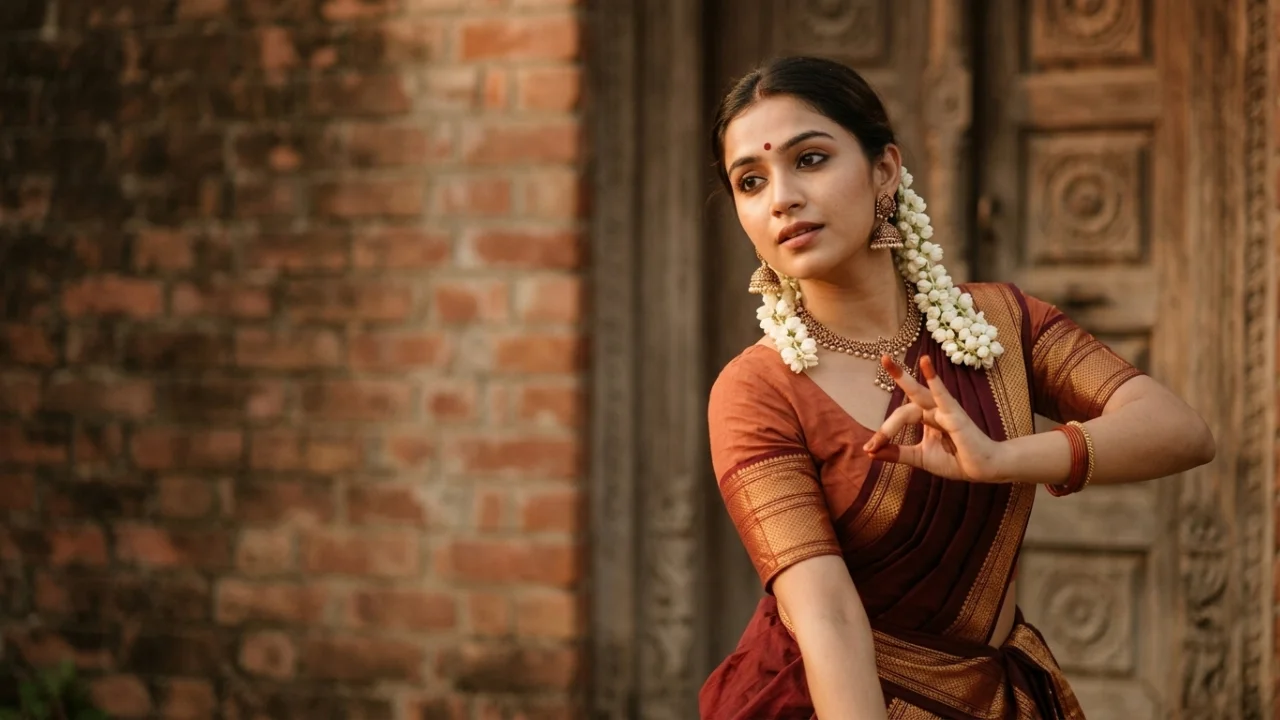
I once watched two dancers perform the exact same line from a dance drama, word for word, same tala, same raga. One made the audience lean forward. The other barely registered. The difference had nothing to do with technique. It came down to tone. That mapping is vachikabhinaya, the vocal register of acting under samanyabhinaya.
Even if you dance a form with no spoken lines at all, this chapter still matters, because every gesture you make is standing in for a voice that would otherwise be speaking. If we get the register wrong, the gesture definitely reads as technically correct but emotionally flat.
This piece picks up where the samanyabhinaya guide left off, moving from the six angikabhinaya components into Bharata muni’s twelve categories of speech-based acting.

We are here, follow us.
What is vachikabhinaya, and why twelve types?
Bharata muni calls these twelve categories vaak-arambha-anubhavas, meaning the basic responses that arise at the start of speech. He is not talking about the dialects or grammar here. He is describing emotional registers, the underlying tone a line carries before a single word leaves the mouth.
These twelve apply just as much to pure nritya forms with no dialogue as they do to spoken drama. A padam line delivered as grief needs a completely different face and body than the same line delivered as a tease.
Vachikabhinaya gives you the vocabulary to name that difference deliberately, instead of guessing at it in rehearsal.
The twelve types of vachikabhinaya

| Type | Meaning | How to perform it |
|---|---|---|
| Aalaapa | Normal conversation with a third person | Neutral tone, open posture, direct gaze toward the implied listener |
| Pralaapa | Meaningless or chaotic babbling | Fragmented, quick head and eye movement, broken rhythm |
| Vilaapa | Words spoken in grief or lament | Slower tempo, downward gaze, trembling in the voice or hands |
| Anulaapa | Repeating the same line multiple times | Slight variation in intensity each repetition, never identical |
| Samlaapa | Sportive or romantic conversation | Playful eyes, lighter footwork, teasing pace |
| Apalaapa | Contradicting or denying what was said earlier | Sharp change in facial expression, a clear pivot moment |
| Sandesha | Carrying a message from one character to another | Formal posture, clear directional gaze toward the message’s recipient |
| Atidesha | Confirming or echoing what someone else said | Nodding quality in the gesture, agreement conveyed through the eyes |
| Nirdesha | Giving a direct instruction | Firm hand gesture, decisive eye contact |
| Vyapadesha | Saying something under a pretext | A slight mismatch between the words implied and the true feeling on the face |
| Upadesha | Offering wisdom or teaching | Calm, measured pace, often with an open palm gesture |
| Apadesha | Quoting someone else’s version of events | A small shift in stance to indicate you are stepping into another voice |
Grouping the twelve for practice
Reading twelve types in a row is not the same as absorbing them. I find it easier to group them by function before drilling each one individually.
The conversational group covers aalaapa, samlaapa, and apalaapa. These three all involve a direct exchange with another person, but the emotional temperature shifts from neutral, to playful, to confrontational. Practice these three back to back on the same line so you feel the pivot between them.


The emotional-overflow group covers pralaapa and vilaapa. Both involve speech that has lost its composure, one through confusion or excitement, the other through sorrow. The trap here is playing both the same way. Pralaapa should feel scattered and quick. Vilaapa should feel heavy and slow, almost dragging.


The relay group covers sandesha, atidesha, and apadesha. All three involve passing along someone else’s words rather than speaking purely from yourself. Sandesha is forward-facing, carrying a message onward. Atidesha is backward-facing, confirming what was already said. Apadesha steps fully into another person’s voice, almost like a brief impersonation.


The instructional group covers nirdesha and upadesha. Both involve authority, but nirdesha is a command and upadesha is guidance. A firm outstretched hand suits nirdesha. A softer, open palm suits upadesha.


Anulaapa and vyapadesha stand a little apart. Anulaapa is about repetition without going flat, adding just enough variation each time so the line does not feel mechanical. Vyapadesha is about disguise, where your words say one thing and your face quietly says another, which makes it one of the more advanced types to perform convincingly.


A simple drill to internalize all twelve vachikabhinaya
Pick one neutral line, something as plain as a phrase describing a garden or a river. Perform it once as aalaapa, then again as samlaapa, then again as vilaapa. Keep the words and the tala completely unchanged across all three attempts.
What you will notice, almost immediately, is how much your gesture vocabulary has to shift even though nothing about the text has changed. The same line performed as samlaapa wants light footwork and playful eyes. Performed as vilaapa, it wants a slower tempo and a downward gaze. That gap between the two performances is exactly what Bharata is asking dancers to control on purpose rather than leave to chance.
Once the drill feels natural on a neutral line, try it on an actual padam or jaavali you already know. Identify which of the twelve types each line in the song belongs to before you touch the tala. You will likely find that a single padam moves through four or five of these registers across its length, and naming each shift ahead of time makes the performance far more deliberate.
How this connects to voice, even in silent dance
Vachikabhinaya was written with spoken drama in mind, since theatre originally combined dialogue with movement. Classical dance inherited the emotional logic of these twelve types without always inheriting the literal speech.
Your face and hands are doing the work a voice would otherwise do, which means the vocal qualities Bharata muni describes elsewhere in the text, like voice registers, intonation, and pause as sense completion, are still relevant even if you never say a word on stage.
If you perform a form that does include recitation, or you work alongside a vocalist delivering the sahitya live, the Sanskrit and Prakrit recitation piece is worth reading next, since it covers how the two spoken registers of classical drama were meant to sound.
Related articles to read with vachikabhinaya
Frequently asked questions about vachikabhinaya
It is the vocal register of acting, twelve categories of speech-based expression called vaak-arambha-anubhavas, used to shape tone even in silent dance.
Because gestures stand in for a voice. Knowing the twelve registers tells you exactly how a line should feel through face and body, not just words.
Aalaapa is neutral, everyday conversation. Samlaapa is the same conversational register but playful and romantic in tone.
Vilaapa is grief-driven, slow and heavy. Pralaapa is confused or chaotic babbling, fast and fragmented. Both lose composure, but in opposite directions.
Pick one neutral line and perform it as aalaapa, then samlaapa, then vilaapa, keeping the words and tala unchanged. The gesture shift shows you the difference.
Share the article
Final thoughts
Twelve categories sound like a lot to memorize, but in practice they are closer to twelve different lenses for the same raw material. Once you can consciously shift a single line between aalaapa and samlaapa and vilaapa, you stop relying on vague instinct to carry your abhinaya and start making deliberate choices, line by line. That is really what Bharata muni is asking for in this chapter. Not more expression, but more precise expression.
References
- Bharata Muni, Natyashastra, chapter on vachikabhinaya and the vaak-arambha-anubhavas, as translated in the wisdomlib digital edition of the Natyashastra.
- Natya-shastra.in resource pages on voice registers, intonation, enunciation, and Sanskrit and Prakrit recitation.
This article continues the samanyabhinaya series. Read the previous piece on sattva and the six angikabhinaya components if you missed it, and the four-fold abhinaya technique guide for the wider framework.
About Natya-Shastra.in
At Natya-Shastra.in, our mission is to serve as a gateway to the illustrious world of the Natyashastra. We offer insights, resources, and a platform to delve deeper into the nuances of Indian performing arts.
Also, we aim to bring forth the richness of this ancient text. We try to shed light on the profound wisdom it holds and its everlasting influence on various artistic traditions.
We are here, follow us.
Disclaimer:
Affiliate Links: Some links earn us a commission (at no cost to you). We only recommend helpful products.
NatyaShastra Glossary: Head over to the Natyashastra Glossary page to know the meaning behind Sanskrit terms used in the articles.
Images & Videos: Representational only, not exact depictions.
Knowledge Source & References: Inspired by ancient Natyashastra scriptures, open to interpretation.

Offer Your Expertise