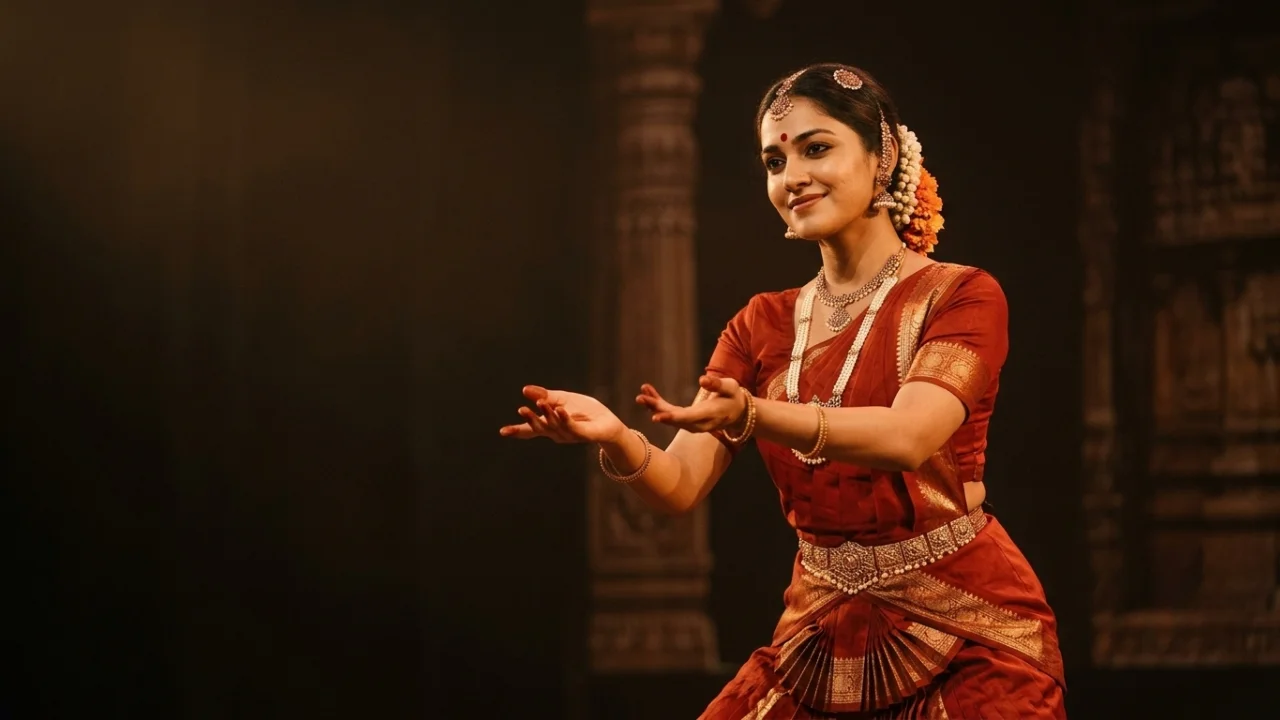
There is a strange problem about involuntary graces hiding inside this chapter of the Natyashastra. Bharata muni describes seven qualities that arise without any conscious effort, then expects performers to somehow produce them on cue, in front of an audience, on a fixed tala.
Effortless and rehearsed are supposed to be opposites. Bharata muni seems unbothered by that contradiction, and once you sit with his definitions for a while, you start to see why. These seven are called involuntary graces (ayatnaja), meaning “spontaneous” or “effortless” or “not born of effort,” and they sit right alongside the ten svabhavaja graces covered in the dasha alankara guide.
Where those ten are triggered by specific emotional situations, like hearing news of a lover or feeling a stolen touch, the seven ayatnaja graces are broader qualities of bearing. They describe how a performer carries themselves overall, not how they react to a single moment.
This piece continues the samanyabhinaya series, following the earlier articles on sattva and the six angikabhinaya components, the twelve types of vachikabhinaya, and the ten natural graces.

We are here, follow us.
The seven involuntary graces

1. Shobha (beauty)
Bharata muni frames shobha specifically as the decoration of the limbs that becomes visible after the fullness of love has been experienced, tied to good physical form, youth, and loveliness rendered outwardly clear. In performance terms, this is the settled, glowing quality a nayika carries after a moment of union or fulfillment rather than during the buildup toward it.


Staging shobha well usually means resisting the urge to add extra gesture right after a climactic romantic moment. A quieter body right after intensity often reads as more convincing than continued movement.
2. Kanti (charm)
Kanti is described as beauty that is fully charged with a lover’s passion. It is shobha with heat added to it, the loveliness of someone visibly caught up in desire rather than simply at rest.
The practical difference between shobha and kanti comes down to intent in the eyes. Shobha can look inward and content. Kanti needs a directional pull toward the beloved, a charge that clearly has somewhere it wants to go.

3. Deepti (radiance)
Deepti is simply kanti taken to a higher intensity, a heightened brilliance built on the same passionate charm. Bharata muni treats it as a matter of degree rather than a separate quality altogether.
On stage, deepti tends to appear in the most emotionally saturated sections of a padam, often right before a climax or a major turning point in the narrative. Reserve your most radiant expression for these peaks. If deepti shows up too early, you have nowhere left to escalate to.
4. Madhurya (delicacy)
Bharata muni’s definition of madhurya is unusually specific. He describes it as moderation in the movement of the limbs across all conditions, and he singles out deepti and lalita in particular as places where this restraint matters most.

This is a useful corrective for dancers who treat radiance as permission to go bigger. Madhurya says the opposite. Even at your most brilliant or your most lolling and leisurely, the limbs should stay measured. Grand emotion delivered through small, controlled movement reads as more sophisticated than grand emotion delivered through large movement.
5. Dhairya (composure)
Dhairya is a natural steadiness of mind, free from rashness or boastfulness, present across every situation a character faces. Bharata muni is describing an internal quality here.

For a performer, dhairya shows up as the ability to stay emotionally grounded through a demanding sequence without letting the technical difficulty leak into the face. A dancer with strong dhairya can execute a physically taxing passage and still look serene doing it, because the composure is genuine rather than a mask held in place through visible strain.
6. Pragalbhya (courage or confidence)
Pragalbhya is the quality of remaining unagitated while speaking or performing any action. It is close to dhairya but more specifically tied to execution under pressure, the confidence that shows up in the moment of doing.
This grace is often most visible in improvisation-heavy moments, such as a manodharma section in Bharatanatyam where a dancer elaborates on a line freely. Pragalbhya is what lets that elaboration look unhurried and sure of itself, even when it is being built in real time.

7. Audarya (dignity or noble bearing)
Audarya is described as courteous bearing maintained across all situations. Where the previous six graces are largely about a performer’s own internal state, audarya has an outward, relational quality to it, a generosity of presence that extends toward the audience and toward other characters on stage.
Practically, audarya is what stops confidence from tipping into arrogance. A dancer with strong pragalbhya but weak audarya can come across as self-assured in a way that feels closed off. Audarya keeps that same confidence open and inviting.

A closing nuance most dancers skip
Bharata muni adds one detail near the end of this section that is easy to miss. He notes that these seven graces should generally be rendered with tenderness in delicate performance contexts, but in other cases they may be shown with brilliance, with one specific exception. Vilasa and lalita are excluded from that brilliant treatment. Both are meant to stay gentle and restrained regardless of the surrounding intensity of the scene.
This is a useful check for choreography. If you find yourself amplifying a vilasa-driven moment or a lalita passage to match the energy of a big finale, Bharata muni’s own text suggests you are working against the grain of those two qualities specifically. Save the amplified, brilliant treatment for the other graces instead.
How to build the conditions for these graces
Since none of the seven can be directly performed the way a hasta can, your training must shift from pure technique to condition building.
Strong technical control matters first, since a body still fighting itself cannot produce dhairya or pragalbhya convincingly. If your basic adavus or nritta vocabulary still require conscious thought, the seven graces will stay out of reach regardless of how much you understand their theory.
Genuine emotional connection to the material matters just as much. Shobha and kanti in particular are described as arising after real passion or real love has been established in the narrative. A dancer who understands exactly why her character feels fulfilled at that point in the padam will produce a more believable shobha than one simply following a choreographed shape.
Stage experience closes the gap. Composure that looks effortless in performance is usually the product of dozens of earlier performances where it did not look effortless at all. Pragalbhya, especially, tends to arrive only after enough repetitions that the nervous system stops treating the stage as a threat.
Related articles
Frequently asked questions
They’re seven qualities of bearing (shobha, kanti, deepti, madhurya, dhairya, pragalbhya, and audarya) that Bharata muni says should appear natural rather than deliberately performed, even though real training sits underneath them.
The ten alankaras are triggered by specific emotional moments, like hearing news of a lover. The seven ayatnaja graces are broader, describing a performer’s overall bearing rather than a reaction to one event.
Not directly. Bharata muni frames them as conditions, not gestures. They emerge once technical control, emotional honesty, and stage experience mature together, rather than being drilled like a hasta.
Vilasa and lalita. Bharata muni specifies they stay gentle and restrained even in high-intensity scenes, unlike the other five graces, which can be rendered with either tenderness or brilliance depending on context.
Trying to perform them directly, as fixed shapes. This usually produces a strained smile or a composed mask instead of genuine effortlessness, because the graces are a byproduct of technique, not a technique themselves.
Share the article
Final thoughts
The seven ayatnaja graces ask for something quieter than most of what a dance student trains toward. There is no hasta to memorize and no rhythm to count. What Bharata muni is really describing is the residue left behind once technique, emotional honesty, and stage experience have all matured together. You cannot shortcut your way to shobha or dhairya.
You can only build the conditions patiently enough that they eventually show up on their own. That is why, they are involuntary graces (effortless).
References
- Bharata Muni, Natyashastra
- Natya-shastra.in resource pages on the ten natural graces, sattvika bhavas, and shringara rasa.
This article continues the samanyabhinaya series. Start from the sattva and angikabhinaya if you are new to this series, or read the dasha alankara piece just before this one.
About Natya-Shastra.in
At Natya-Shastra.in, our mission is to serve as a gateway to the illustrious world of the Natyashastra. We offer insights, resources, and a platform to delve deeper into the nuances of Indian performing arts.
Also, we aim to bring forth the richness of this ancient text. We try to shed light on the profound wisdom it holds and its everlasting influence on various artistic traditions.
We are here, follow us.
Disclaimer:
Affiliate Links: Some links earn us a commission (at no cost to you). We only recommend helpful products.
NatyaShastra Glossary: Head over to the Natyashastra Glossary page to know the meaning behind Sanskrit terms used in the articles.
Images & Videos: Representational only, not exact depictions.
Knowledge Source & References: Inspired by ancient Natyashastra scriptures, open to interpretation.

Offer Your Expertise