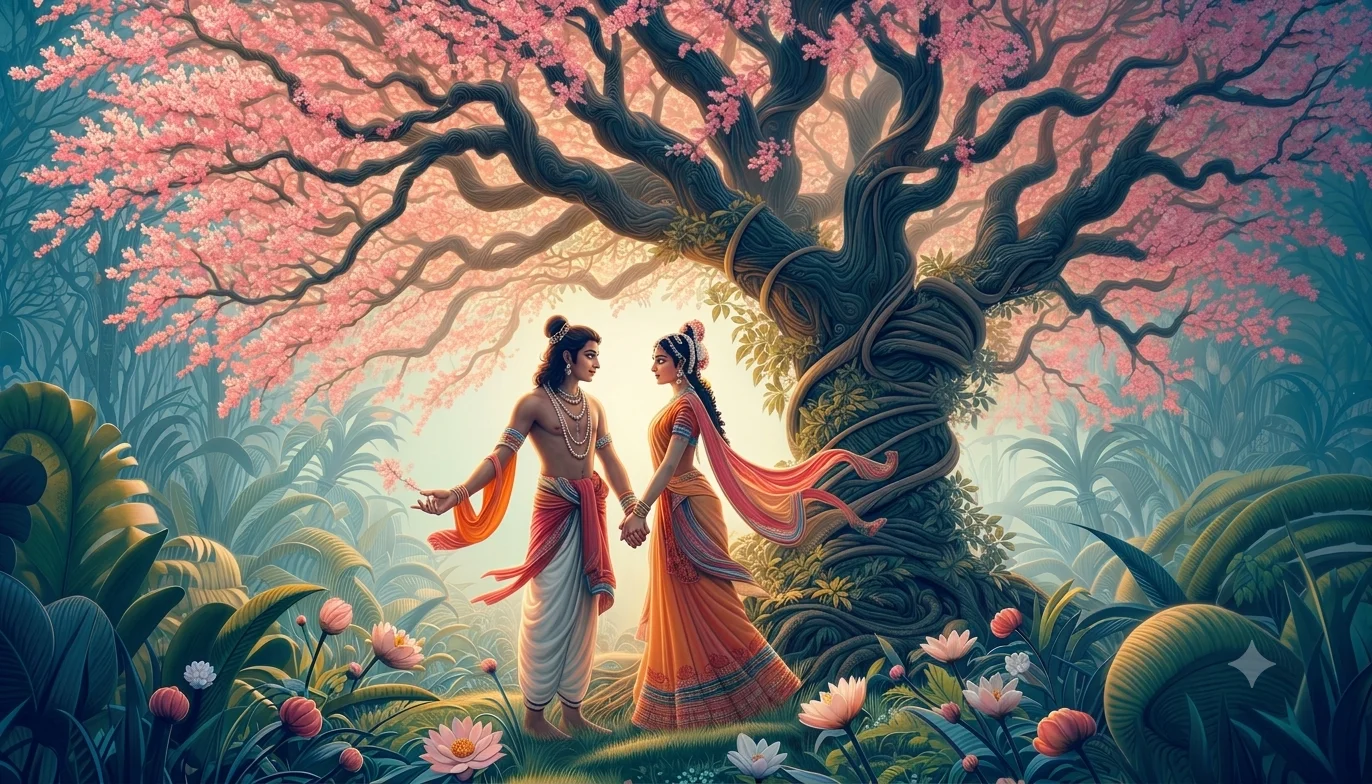
Sringara Rasa is the most sensual and the primary rasa of the eight sentiments mentioned in Natyashastra. By now, we know that rasas are the fundamental emotions or flavors experienced in the arts, particularly in drama, literature, and music.
If you are new to Rasa, read this article dedicated to decoding what a Rasa is all about.
In this article, we will explore the origins, characteristics, and emotional states that define Sringara Rasa.

The Essence of Sringara (Śṛṅgāra) Rasa
Defining Sringara
Sringara or Śṛṅgāra, or the Erotic Rasa, arises from the Staibhāva of Rati (love). The emotion is of brightness and attractiveness. Anything pure, delightful, bright, or pleasing in the world is comparable to Śṛṅgāra.

"तत्र शृङ्गारो नाम रतिस्थायिभावप्रभवः । उज्ज्वलवेषात्मकः"
"tatra śa्ṛṅgāro nāma ratisthāyibhāvaprabhavaḥ | ujjvalaveṣātmakaḥ"
We are here, follow us.
Traditional and Authoritative Origins of Sringara Rasa
He who is well-dressed is called Śṛṅgāravān (one who possesses Śṛṅgāra). Just as names in society arise from family and traditional practices, so too do the names of Rasas and Bhāvas in drama arise from their respective traditions and authoritative teachings.
Thus, this Rasa is established by tradition and characterized by attractiveness and brightness.

"एवमेष आचारसिद्धो हृद्योज्ज्वलवेषात्मकत्वाच्छृङ्गारो रसः"

"evameṣa ācārasiddho hṛdyojjvalaveṣātmakatvācchṛṅgāro rasaḥ"

Pure 92.5 silver Lakshmi Design Temple Pendant

Pure 92.5 Silver Gold Plated Silver Temple Earring

Paisley-Mango 92.5 Pure Silver Temple Necklace

Pure 92.5 Silver,Temple Necklace with Dangling Pearls
Śṛṅgāra is caused by the interaction of a man and a woman, and it is naturally found in the prime of youth.
It has two divisions:
- Sambhoga (union)
- Vipralambha (separation).

"स च स्त्रीपुरुषहेतुक उत्तमयुवप्रकृतिः"

"तस्य द्वे अधिष्ठाने सम्भोगो विप्रलम्भश्च"

"sa ca strīpuruṣahetuka uttamayuvaprakṛtiḥ"

"tasya dve adhiṣṭhāne sambhogo vipralambhaśca"

Get featured on this blog?
Submit your videos and images of you performing classical dance!
We’d love to showcase your talent and passion for classical dance with the world.
Sambhoga Śṛṅgāra: The Joy of Union
Determinants (Vibhāvas) of Sambhoga Śṛṅgāra
Sambhoga Śṛṅgāra arises from determinants such as:
- The season (ऋतु)
- Garlands (मालामय)
- Anointments
- Ornaments
- Presence of the beloved (प्रियसंवास)
- Enjoyment in pleasant places (सुखकार स्थान)
- Walks in gardens
- Experiencing, hearing, seeing, playing, and other such activities

"तत्र सम्भोगस्तावत् ऋतुमाल्यानुलेपनालङ्कारेष्टजनविषयवरभवनोपभोगोपवन-गमनानुभवनश्रवणदर्शनक्रीडालीलादिभिर्विभावैरुत्पद्यते"

"tatra sambhogastāvat ṛtumālyānulepanālaṅkāreṣṭajanaviṣayavarabhavanopabhogopavana-gamanānubhavanaśravaṇadarśanakrīḍālīlādibhirvibhāvairutpadyate"
Expressions (Anubhāvas) of Sambhoga Śṛṅgāra
Its expression (Abhinaya) is through Anubhāvas such as:
- Clever glances
- Raised eyebrows (उत्क्षिप्त)
- Side glances (सकटाक्ष)
- Elegant and sweet gestures (ललित)
- Words

"तस्य नयनचातुर्यभ्रूक्षेपकटाक्षसञ्चारललितमधुराङ्गहार-वाक्यादिभिरनुभावैरभिनयः प्रयोक्तव्यः"

"tasya nayanacāturyabhrūkṣepakaṭākṣasañcāralalitamadhurāṅgahāra-vākyādibhiranubhāvairabhinayaḥ prayoktavyaḥ"
Transitory States (Vyabhicāribhāvas) Excluded from Sambhoga
The transitory states that are not compatible with Sambhoga Śṛṅgāra include:
- Lethargy (स्वापव्यसन)
- Anger (क्रोध)
- Disgust (बीभत्स)

"व्यभिचारिणश्चास्यालस्यौग्र्यजुगुप्सावर्ज्याः"

"vyabhicāriṇaścāsyālasyaugryajugupsāvarjyāḥ"
Vipralambha Sringara (Śṛṅgāra): The Sorrow of Separation
Vipralambha Śṛṅgāra is depicted through experiences such as:
- Dejection (विषाद)
- Languor (ग्लानि)
- Suspicion (विप्रतिपत्ति)
- Jealousy (मात्सर्य)
- Fatigue (परिश्रान्ति)
- Anxiety (चिन्ता)
- Longing (अभिध्या)
- Sleep
- Dreaming (स्वप्नवस्था)
- Waking
- Illness
- Insanity (उन्मद)
- Intoxication (मद)
- Epilepsy (भ्रामर)
- Lethargy (स्वापव्यसन)
- Death (मरण)

"विप्रलम्भकृतस्तु निर्वेदग्लानिशङ्कासूयाश्रमचिन्तौत्सुक्यनिद्रास्वप्नविबोधव्याध्युन्माद-मदापस्मारजाड्यमरणादिभिरनुभावैरभिनेतव्यः"

"vipralambhakṛtastu nirvedaglāniśaṅkāsūyāśramacintautsukyanidrāsvapnavibodhavyādhyunmāda-madāpasmārajāḍyamaraṇādibhiranubhāvairabhinetavyaḥ"
Sringara Integrates All Bhāvas
In this way, Sringara encompasses all Bhāvas (emotions), highlighting its integral role in drama.
Articles for you about NatyaShastra
- NatyaShastra: The Ancient Blueprint Of Storytelling
- Bharata Muni and the Sages Discuss the Soul of Natyashastra
- Three Definitions Of Natya (Drama)
- The Birth Of NatyaVeda
- Who Was Bharata Muni And His 100 Sons?
- The Birth of the Apsaras for the Kaishiki Style
- The Origins of Indian Theatre as per NatyaShastra
- Two Kinds of Preliminaries in Classical Indian Dance
- Recaka in Indian Classical Dance: Nuances of Movement
- Pindibandha: India’s Ancient Group Dance Technique As Explained In Natyashastra
- Angaharas: The Building Blocks of Indian Classical Dance
- Samyuta Hastas: 24 Double Hand Gestures as per Shastras
- Asamyuta Hastas: 28 Single Hand Gestures as per Shastras
Share the article
Frequently Asked Questions
Sringara Rasa is the Erotic Rasa, arising from the permanent mood of love (Rati). It is characterized by attractiveness, and brightness and is associated with union (Sambhoga) and separation (Vipralambha).
Karuna Rasa, which arises from suffering and loss, is integrated into Sringara Rasa through its expression in Vipralambha (separation), thus encompassing a wide range of emotional experiences.
Conclusion
A well-dressed man enjoys garlands and perfumes and is associated with a woman who is said to be experiencing Sringara. This Rasa, with its dual nature of union and separation, captures the essence of human emotional experience, emphasizing both joy and sorrow in the context of love and relationships.
About Natya-Shastra.in
At Natya-Shastra.in, our mission is to serve as a gateway to the illustrious world of the NāṭyaŚāstra, offering insights, resources, and a platform to delve deeper into the nuances of Indian performing arts. We aim to bring forth the richness of this ancient text, shedding light on the profound wisdom it holds and its everlasting influence on various artistic traditions.
We are here, follow us.
Disclaimer:
Affiliate Links: Some links may earn us a commission (at no cost to you). We only recommend helpful products.
NatyaShastra Glossary: Head over to the Natyashastra Glossary page to know the meaning behind Sanskrit terms used in the articles.
Images & Videos: Representational only, not exact depictions.
Knowledge Source & References: Inspired by ancient Natyashastra scriptures, open to interpretation.
Disclaimer: Educational only, not professional advice. Consult a qualified expert for specific needs.

Offer Your Expertise