Estimated reading time: 8 minutes
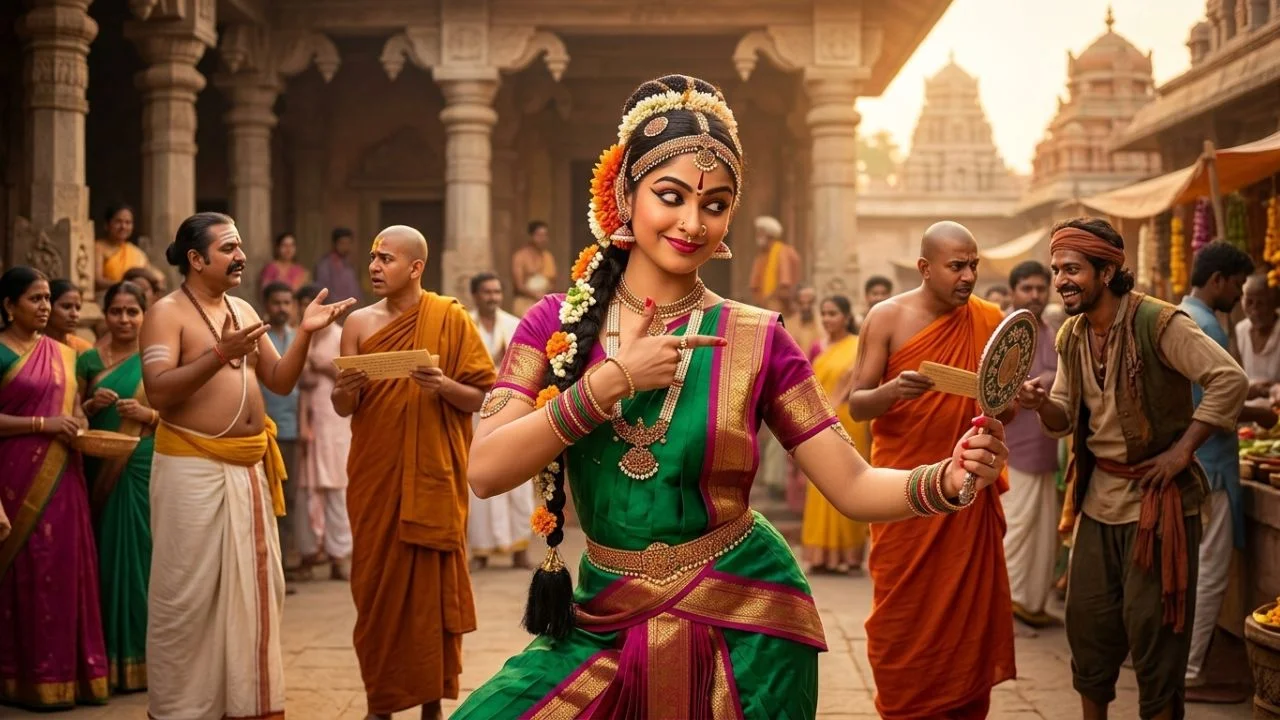
Comedy is the hardest thing to teach. Tragedy follows rules everyone recognizes. But comedy? It depends on timing, context, transgression, and a precise understanding of what an audience finds absurd. Sage Bharata dedicates specific verses to the Prahasana, a form in the Dasarupaka classification, and what he describes is not frivolous entertainment. It is a structured, socially aware dramatic form that uses laughter as its primary instrument of truth-telling.

What is Prahasana in the Dasarupaka framework?
Prahasana is a comic dramatic form rooted in satire, designed to expose hypocrisy, moral decay, and social contradictions through humor.
Unlike light entertainment, its goal is pointed. It uses laughter as a tool. The Nāṭyaśāstra defines two clear types:
- Śuddha Prahasana (Pure)
- Miśra Prahasana (Mixed)
Both rely heavily on vācika abhinaya (speech), supported by āṅgika and sāttvika abhinaya to heighten comic and psychological depth.
For a broader structural understanding, refer to the foundational guide on Dasarupakas.
Śuddha Prahasana: “pure” satirical form
Śuddha Prahasana includes:
- Śaiva ascetics
- Bhikṣus (monks)
- Śrotriya Brahmins
- Lower-class characters who inject humor
This mix is deliberate. The contrast between external piety and internal contradiction creates the dramatic tension.
Performance approach
1. Build comic disputation
The core of Śuddha Prahasana lies in verbal exchanges.
- Use layered dialogue.
- Arguments must feel intellectual but subtly absurd.
- Each character defends their position with misplaced seriousness.
Example
A Brahmin insists on ritual purity while secretly breaking his own rules. A monk challenges him using scriptural logic, but reveals his own ignorance in the process.
2. Language realism
Natyashastra emphasizes realistic language.
- Sanskritized speech for learned characters
- Prakrit or regional tones for lower-class roles
- Slight exaggeration, but never distortion
With this authenticity, the audience must recognize the world being mocked.
3. Psychological detailing
Each character’s inner state must be clear.
- Pride masked as humility
- Ignorance disguised as scholarship
- Desire hidden behind renunciation
Use micro-expressions, pauses, and eye work. Here, abhinaya becomes powerful.
4. Humor through exposure
Forced comedy becomes a failure here. So, let the humor emerge from contradiction.

Miśra Prahasana: “mixed” satirical form
Miśra Prahasana introduces more socially dynamic characters:
- Courtezans
- Servants
- Eunuchs
- Viṭas (witty gallants)
- Dhūrtas (rogues)
- Unchaste women
Here, the tone becomes more earthy, playful, and visually expressive.
Performance approach
1. Use costume and movement as satire
Unlike Śuddha Prahasana, Miśra relies strongly on visual cues.
- Overdressed characters to signal vanity
- Stylized gait for courtezans
- Loose, exaggerated body language for rogues
Movement itself becomes commentary.
2. Introduce scandal or hypocrisy
The Natyashastra explicitly instructs this.
- A fake ascetic exposed in a love scandal
- A clever courtesan manipulating elite patrons
- Rogue creating chaos through gossip
The narrative must revolve around social exposure.
3. Structure through Vithi elements
Prahasana can borrow from Vīthi, a minor dramatic form.
This allows:
- Fragmented scenes
- Sudden entries and exits
- Improvised-feeling interactions
It keeps the rhythm fast and engaging.
For deeper staging techniques, see:
Abhinaya techniques for Prahasana
Vācika abhinaya
This is the backbone. Use,
- Sharp timing
- Controlled pitch variation
- Strategic pauses for comedic effect
A well-timed silence often gets the biggest reaction!
Angika abhinaya
Use the body to support irony.
- Raised eyebrows for mock seriousness
- Slight shoulder tilts to suggest doubt
- Controlled exaggeration in gestures
Sattvika abhinaya
Subtle but crucial.
- Internal conflict
- Sudden realization
- Embarrassment
These moments ground the humor.
Structuring a Prahasana performance
Opening
- Introduce characters quickly
- Establish the social setting
- Hint at the central hypocrisy
Middle
- Build conflict through dialogue
- Layer misunderstandings
- Increase tempo gradually
Climax
- Reveal the truth
- Expose contradictions
- Let humor peak through recognition
Resolution
- Keep it light
- Avoid moral preaching
- End with a sense of release
Staging a Prahasana scene
Scenario
A self-proclaimed ascetic visits a wealthy patron.
Execution
- Entry with exaggerated dignity
- Subtle signs of indulgence in costume and behavior
- Dialogue filled with spiritual jargon
- Gradual exposure through servant’s observations
- Final reveal through contradiction in action
The humor lands because the audience sees the truth before the character does.
Language and Dialect
One of the most sophisticated aspects of the Prahasana is its multilingual texture. Characters in Indian classical drama speak according to their social rank and gender, a convention the Natyashastra establishes across multiple chapters. In the Prahasana, this convention becomes a comic tool.
The Shrotriya Brahmin speaks Sanskrit. The courtesan speaks Shauraseni Prakrit. The low-class character uses an even more localized dialect. When these characters argue or interact, the collision of language registers itself communicates social comedy. A performer working in the shuddha Prahasana needs to understand this multilingual architecture, not just as a historical fact but as an active performance choice.
Abhinaya and Physical Expression
The Prahasana relies heavily on physical comedy, but this must be disciplined. Bharata’s description of the mixed Prahasana’s characters emphasizes their “immodest appearance, dress and movements.” These are not accidents. The performer must make deliberate choices about how each character carries the body, what their entry communicates, how they move in relation to other characters.
The Sattvikabhinaya (internal emotional expression through involuntary physical signs) is crucial even in comedy. Genuine laughter, real nervousness, authentic embarrassment: these create the emotional texture that separates Prahasana from mere clowning. The actor playing the false ascetic must find the real vanity inside the character, not just perform it externally. The audience should laugh, but they should also recognize.
The Hasya Rasa in Performance
The hasya rasa, the comic sentiment, is the dominant rasa in the Prahasana. But Bharata’s system of rasas is not about a single emotion filling a scene. The hasya rasa emerges from specific bhavas (psychological states) including hasa (laughter), apasmara (confusion), tandra (drowsiness), and others. A skilled Prahasana performer modulates these bhavas to create comic rhythm.
Timing is inseparable from this. The moment before a character’s pretension collapses is as important as the collapse itself. The audience needs a fraction of a second to recognize the contradiction before they laugh. This is what distinguishes trained Prahasana performance from undisciplined buffoonery.
The Sutradhra and Opening Context
In classical practice, the Sutradhara (stage manager/narrator) opens most dramatic performances. In the Prahasana, the Sutradhara’s role in the Purvanga (preliminaries) must establish the comic frame without giving away the specific joke. The audience needs to know they are entering a comic world, but the specific targets of the comedy should unfold through the drama itself.
Related articles
Frequently Asked Questions
Prahasana is a satirical dramatic form within the Dasarupaka system that uses humor, dialogue, and character contrast to expose hypocrisy and social flaws.
Two types are described: Śuddha (pure), focused on learned and ascetic characters, and Miśra (mixed), which includes courtezans, rogues, and socially dynamic figures.
Its purpose is to critique society through laughter, revealing contradictions in behavior, morality, and belief systems.
Vācika abhinaya plays the central role, as dialogue and verbal exchanges drive the humor and satire.
Yes. Modern adaptations can retain the structure while using contemporary social themes, as long as satire and character integrity remain intact.
Final thoughts
Prahasana is a fully theorized dramatic form with its own social logic, its own performative demands, and its own relationship to the culture that produces it. Bharata’s two-verse definition of each type is dense and compressed, as the Natyashastra always is, but the implications are extensive.
What Bharata understood, and what the surviving Prahasana texts confirm, is that comedy structured around recognizable social hypocrisy is not trivial. It is one of the most precise ways a performing tradition can reflect a society back to itself. The false mentor, the pompous ascetic, the cheerful rogue, these figures have not disappeared. The Prahasana gives performers a rigorous, ancient, surprisingly flexible set of tools to put them on stage.
Study the form. Learn its two types. Find the Vithi elements that fit your premise. Then trust that laughter, when it comes from somewhere true, is as profound as any other dramatic sentiment.
About Natya-Shastra.in
At Natya-Shastra.in, our mission is to serve as a gateway to the illustrious world of the Natyashastra. We offer insights, resources, and a platform to delve deeper into the nuances of Indian performing arts.
Also, we aim to bring forth the richness of this ancient text. We try to shed light on the profound wisdom it holds and its everlasting influence on various artistic traditions.
We are here, follow us.
Disclaimer:
Affiliate Links: Some links earn us a commission (at no cost to you). We only recommend helpful products.
NatyaShastra Glossary: Head over to the Natyashastra Glossary page to know the meaning behind Sanskrit terms used in the articles.
Images & Videos: Representational only, not exact depictions.
Knowledge Source & References: Inspired by ancient Natyashastra scriptures, open to interpretation.

Offer Your Expertise