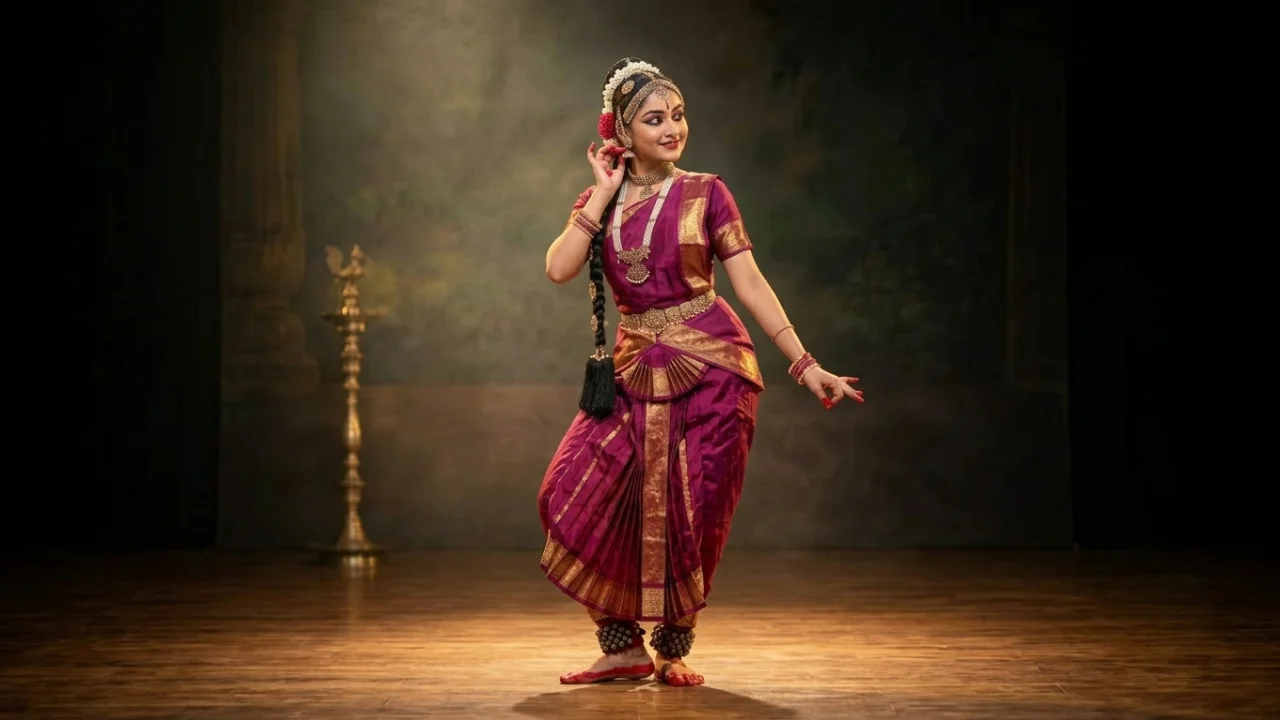
Bharata muni names four ways love begins, and two of them need no eyes at all. A voice heard from another room can do it. So can a stranger’s charm in conversation. That detail changed how I think about a first meeting on stage, because the dancer does not have to wait for the gaze to start the story. Let’s understand the signs of love detailed in Natyashastra.

We are here, follow us.
What Bharata muni means by love on stage
The feeling behind this passage is rati, the durable emotion that ripens into Sringara rasa. Bharata muni says it appears in three grades, superior, middling and inferior, in poeple. Grade matters here. A superior love looks restrained and steady, while an inferior love looks hurried and loud.

The passage sits inside the wider system of bhava, rasa, vibhava and anubhava. First come the causes (vibhava). Then come the visible results (anubhava). Keep this split in mind. You first decide why she loves, then decide how it shows.
How love begins: the four causes
1. Hearing and conversation
Bharata muni says love grows from hearing about a person and from charming talk. On stage this means the beloved can be absent. Let the dancer react to a name, a song or a described virtue.

2. Seeing beauty and playful movement
Personal beauty and the sportive movement of limbs come next. Each movement counts as a cause, so the beloved’s walk, turn or gesture can become the spark. The erotic gait described in Natyashastra gives you a way to show the beloved’s movement before the lover reacts to it.
3. Qualities and skills
A woman becomes overpowered on seeing a young man who has beauty, innate qualities and knowledge of arts and crafts. This is a reminder that admiration for skill can be a actual cause of love. A dancer can show it by just watching hands too.
4. The observer’s duty
Bharata muni then tells an expert to observe the indications of love in people who desire each other’s company. I take this as advice to the performer and the connoisseur. Watch real people first in the real world. Then perform the character. That is why you’ll see a lot of actors (mostly biographies) spending time with the actual person to learn and understand the minute details.
The signs of love in the eyes and face
Kamya (love glance)
Bharata muni describes eyes that are sportive, tearful and half-closed, with a drooping upper lid and throbbing lashes create kamya. Let’s build it in layers that’s easy to perform.
- Lower the upper lids to half height. Keep the pupils soft and unfocused.
- Hold the breath for a beat so the eyes gather moisture.
- Add a small lash tremor. It should look involuntary, so keep it tiny.
- Hold for four counts without blinking on schedule.
If your eyes are wide, they ruin this glance. It’s about narrowing them that creates the effect. The thirty-six glances and the article on eyeballs and eyelids (Dhristi Bedha) will help you refine the your glance.

Lalita (sportive glance)
Here the eyes extend to the corners with a smiling, playful quality. Bharata muni assigns it to women’s partial looks, meaning sidelong or half-turned ones. To perform this, widen the eyes sideways, not upward. Let your smile sit in the outer corner and the cheek. Turn the face slightly away and look back from the edge of the eye. That small turn is where the play happens!
Colour (sweat and bristling hair)
Slightly reddened cheeks, drops of sweat and standing hair mark love. These belong to the sattvika bhavas, the involuntary states that arise from inner feeling. You cannot fake them well with technique alone. I suggest a light cheek tint from make-up as support. Then hold a precise inner image and let the breath and stillness carry the rest.

Pure 92.5 silver Lakshmi Design Temple Pendant

Pure 92.5 Silver Gold Plated Silver Temple Earring

Paisley-Mango 92.5 Pure Silver Temple Necklace

Pure 92.5 Silver,Temple Necklace with Dangling Pearls
The courtesan’s love
Bharata muni lists seven actions for a courtesan overpowered by love: side-long glances, touching ornaments, itching the ears, scratching the ground with the toes, showing the navel, cleansing the nails and gathering the hair. Her signs are open and directed them at the beloved.

If you wish to incorporate these into the act, do not stack all seven. Pick two or three and place them on the beats of the music or verse. Scratching the ground with the toes gives you a reason to look down, which sets up the next sidelong glance.
Dhananjaya’s Dasarupaka, is a good read here.
Love in a woman of high family
This heroine’s signs are the reverse of the courtesan’s. She looks continuously with blooming eyes. She hides her smile and speaks slowly with a lowered face, answers with a smile, conceals sweat and appearance, and shows throbbing lips and trembling.

So the acting task is to hide and fail. Let one sign leak per line of text, then cover the one before it. The audience reads the effort of hiding as love.
| Love Acting | Courtesan | Woman of high family |
|---|---|---|
| Direction of signs | Toward the beloved | Away, then leaking the expression |
| Gaze | Sidelong, inviting | Continuous, then lowered |
| Body | Touches ornaments, hair, ears | Trembles, lips throb |
| Speech | Free | Slow, downcast |

A twenty minute rehearsal routine to learn the signs of love
- Spend five minutes on Kamya alone. Work only the lids and the breath.
- Spend five minutes on Lalita. Practice the turn and the corner look in a mirror.
- Perform one line of text as a courtesan, using three signs only.
- Perform the same line as a woman of high family, hiding two of the signs you just used.
- Finish with two stages of the maiden’s sequence and note which one your body resists.
Related articles
Frequently asked questions
Bharata muni describes loving glances, reddened cheeks, sweat and bristling hair. He also gives separate actions for a courtesan, a woman of high family and a young maiden.
It is a loving glance with sportive, tearful, half-closed eyes, a drooping upper lid and throbbing lashes.
The eyes extend to the corners with a smiling, playful look. Bharata muni assigns it to women’s partial, sidelong looks.
A courtesan shows love openly through sidelong glances and touching her ornaments or hair. A woman of high family conceals it, hiding her smile and speaking slowly with a lowered face while trembling betrays her.
Ten. Ghosh’s translation names them as longing, anxiety, recollection, praising qualities, agitation, lament, madness, sickness, stupor and death.
Share the article
Final thoughts
Bharata muni gives us a compact map of love: how it starts, how it looks in the eyes and skin, and how a woman’s social position changes its expression. I would start with concealment, because it teaches the most about restraint and audience attention. To test what you have practiced, try the Rasa and Bhava Explorer or read the full four-fold abhinaya guide.
References
- Bharata Muni, Natyashastra
- Abhinavagupta, Abhinavabharati
- Dhananjaya, Dasarupaka
- Nandikesvara, Abhinayadarpana
About Natya-Shastra.in
At Natya-Shastra.in, our mission is to serve as a gateway to the illustrious world of the Natyashastra. We offer insights, resources, and a platform to delve deeper into the nuances of Indian performing arts.
Also, we aim to bring forth the richness of this ancient text. We try to shed light on the profound wisdom it holds and its everlasting influence on various artistic traditions.
We are here, follow us.
Disclaimer:
Affiliate Links: Some links earn us a commission (at no cost to you). We only recommend helpful products.
NatyaShastra Glossary: Head over to the Natyashastra Glossary page to know the meaning behind Sanskrit terms used in the articles.
Images & Videos: Representational only, not exact depictions.
Knowledge Source & References: Inspired by ancient Natyashastra scriptures, open to interpretation.

Offer Your Expertise