Estimated reading time: 6 minutes
As artists, we know that the essence of the drama intensifies in a tighter frame. This is exactly the spirit of Vyayoga, one of the ten forms under the Dasarupaka. It is brief, forceful, and built on confrontation.

We are here, follow us.
What is Vyayoga
Vyayoga is a one-act dramatic form centred on a well-known heroic figure, often drawn from Itihasa. The story unfolds within a single day and focuses on conflict-driven action.
Core features of Vyayoga
- One act only
- Story duration limited to one day
- A famous male hero, often a royal sage or warrior
- Minimal female presence
- Dominance of वीर (Veera) and रौद्र (Raudra) rasas
- Themes of battle, challenge, confrontation, and tension

Structure of a Vyayoga performance
One act and that is the complete arc
Unlike Nataka or Prakarana, Vyayoga does not allow narrative expansion.
You must compress:
- Introduction
- Conflict
- Confrontation
- Resolution
All within one seamless act.
On stage approach
Start late in the story.
Do not build slowly. Enter at the moment of tension. For example, if you stage a Bhima episode, begin when conflict is already inevitable. Let the audience catch up through dialogue and action.

The hero in Vyayoga
The hero must be:
- Well-known
- Strong in presence
- Grounded in human action, not divine abstraction
The text clearly avoids divine protagonists. Even if the character is mythological, the portrayal must feel human.
Focus on Angika Abhinaya:
- Firm stance
- Controlled gait
- Sharp directional glances
Voice must carry authority. Here, dialogue delivery is direct and there is no excessive lyrical softness.
Example:
A warrior announcing a challenge should sound like a command, not a request.

Managing characters on stage
Male dominance, minimal female roles
Vyayoga reduces romantic or delicate emotional layers. Female characters are few and functionally placed.
Even though multiple male characters may appear, avoid the scale of Samavakara.
Keep interactions tight:
- Duels
- Verbal confrontations
- Short exchanges
Every character must serve the central conflict.
Rasa and emotional design
Dominant rasas
Supporting rasas may appear briefly, but do not dilute the tone.
How to evoke Veera and Raudra
Use:
- Strong chest expansion
- Quick, decisive gestures
- Elevated vocal pitch during confrontation
Raudra must not become uncontrolled shouting. It requires precision, i.e, anger with direction.
Action elements: the heart of Vyayoga
The Natyashastra clearly states:
- Battle
- Personal combat
- Challenge
- Angry exchanges
These are purely essential for Vyayoga kind of act.
Staging combat
Use stylised choreography:
Think of it as controlled energy.
Example:
A duel can be shown through alternating diagonals, sharp turns, and synchronized strikes. There is no need for real contact, unless you plan to have for more impact.
Language and dialogue
Vyayoga avoids elaborate poetic indulgence.
Dialogue should:
- Move the story forward
- Reveal conflict
- Build intensity
Delivery tips
- Use pauses strategically
- Maintain eye focus
- Keep sentences sharp
This creates tension without excess movement.
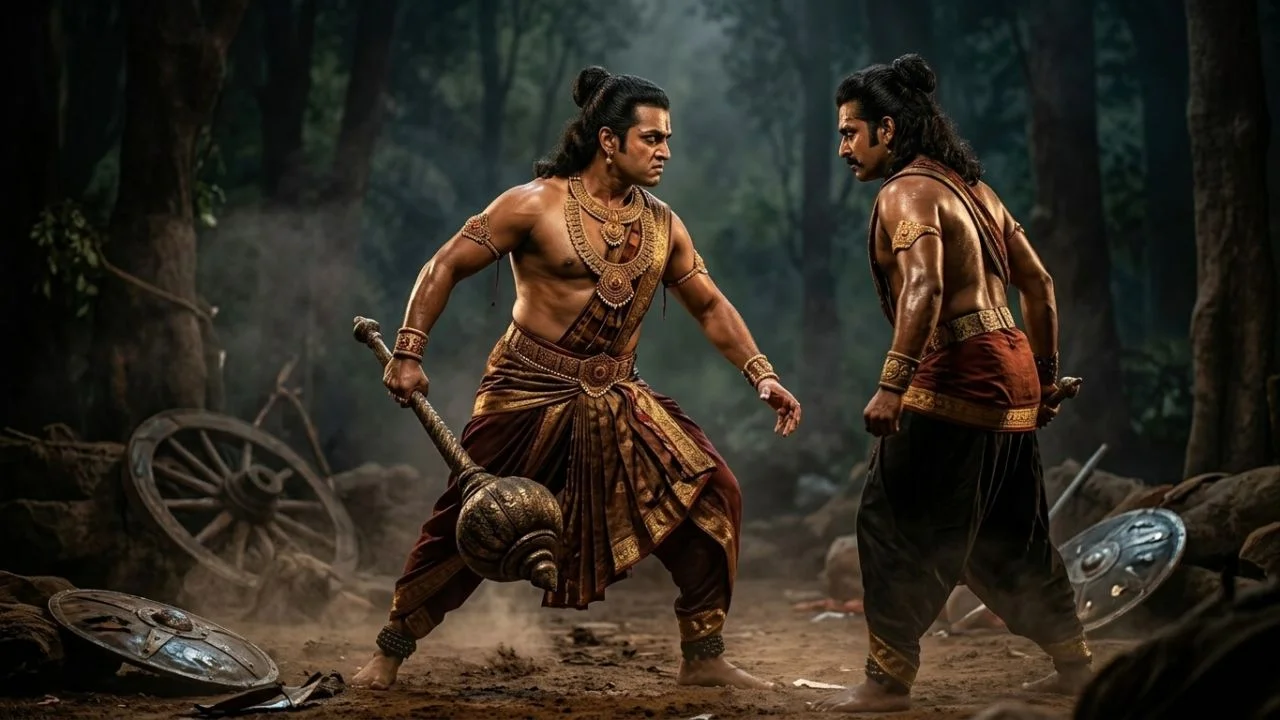
Example: staging a Bhima episode
Imagine Bhima confronting an enemy in exile.
- Entry: Bhima already searching
- Conflict: Enemy challenges him
- Build: Verbal tension rises
- Climax: Combat sequence
- Resolution: Victory or moral closure
Here, if you observe, there are no diversions or subplots.
Position within Dasarupaka
Within the Dasarupaka, Vyayoga serves as the compressed action form.
Compare:
- Nataka explores grandeur
- Prakarana explores society
- Vyayoga explores conflict in its purest, shortest form
It is closer to a dramatic strike than a narrative journey.
Related articles
Frequently Asked Questions
Vyayoga is a one-act dramatic form described in the Natyashastra as part of Dasarupaka. It focuses on a well-known heroic figure, intense conflict, and events that unfold within a single day.
Within the Dasarupaka system, Vyayoga is the most compact and action-driven form. It avoids multiple acts, elaborate subplots, and large emotional variations.
The hero should be a famous, strong male figure such as a warrior or royal sage. The portrayal must feel human, even if the character comes from epic literature.
Veera (heroic) and Raudra (furious) rasas dominate, supported by strong physical expression and controlled emotional intensity.
No. Vyayoga minimizes romantic elements and avoids multiple subplots. The focus remains on a single conflict and its resolution within one act.
Share the article
Final thoughts
Vyayoga demands discipline as it tests a performer’s ability to do more with less.
It is of short duration and limited characters of high intensity.
When performed well, it feels like a burst of energy that leaves the audience alert and charged. That is its strength.
If you master Vyayoga, you sharpen your command over timing, presence, and emotional precision. And that skill carries into every other form of performance.
About Natya-Shastra.in
At Natya-Shastra.in, our mission is to serve as a gateway to the illustrious world of the Natyashastra. We offer insights, resources, and a platform to delve deeper into the nuances of Indian performing arts.
Also, we aim to bring forth the richness of this ancient text. We try to shed light on the profound wisdom it holds and its everlasting influence on various artistic traditions.
We are here, follow us.
Disclaimer:
Affiliate Links: Some links earn us a commission (at no cost to you). We only recommend helpful products.
NatyaShastra Glossary: Head over to the Natyashastra Glossary page to know the meaning behind Sanskrit terms used in the articles.
Images & Videos: Representational only, not exact depictions.
Knowledge Source & References: Inspired by ancient Natyashastra scriptures, open to interpretation.

Offer Your Expertise