Estimated reading time: 11 minutes
One aspect of an entire production of a play depends on costumes and make-up. Bharata Muni says this so plainly in the Natyashastra that it is easy to read past it. Only with the type of makeup, the audience has already decided who that person is on stage. A god, a demon, a king, a farmer. The decision happens through character colours.
In this article, we discuss what sometimes is called the varna vidhana or “rule of colours,” in practical detail. It is part of aṅgaracanā, painting the limbs, one of the four branches of nepathya (costumes and make-up) under āhāryābhinaya.
If you already know the four facial colours of mukharāga (svābhāvika, prasanna, rakta, śyāma) from the standard makeup literature, this is a different, more granular layer sitting underneath it: not “what emotion does this face show,” but “what colour is this being, by nature, birth and place of origin.” Think of mukharāga as the mood lighting and varna vidhana as the base coat that decides who is standing under it.

We are here, follow us.
Why Bharata bothered with this much detail
Back then, theatre was performed in daylight or by torchlight, often at some distance from the audience, sometimes to hundreds of people at once. There were no subtitles, no programme notes explaining that the actor in the third row was playing Indra rather than a random courtier. Character colours had to do that work instantly, and it had to do it consistently, production after production, troupe after troupe, so that a Kashi audience and a Magadha audience read the same character the same way.
Bharata muni assigns colour by category (deity, demigod, human), then narrows by sub-category (region, group, caste, moral conduct), so a make-up artist working from the text has a decision tree rather than a vague suggestion. It is worth reading alongside the fuller discussion of nepathya’s four categories, since character colours is only one of the systems working in concert with ornament, props and living creatures on a Natyashastra stage.
The gods: gold, white, and a few deliberate exceptions
Gods in general, along with Yakshas and Apsaras, are reddish yellow. But a handful get their own treatment:


- Rudra, Arka (the Sun), Druhina (Brahma) and Skanda are the colour of gold.
- Soma (the Moon), Brihaspati, Shakra (Indra), Varuna, the stars, the ocean, the Himalayas and the Ganga are white, grouping deity with the natural feature associated with them.
- Angaraka (Mars) is red.
- Budha (Mercury) and Hutashana (Agni, fire) are yellow.
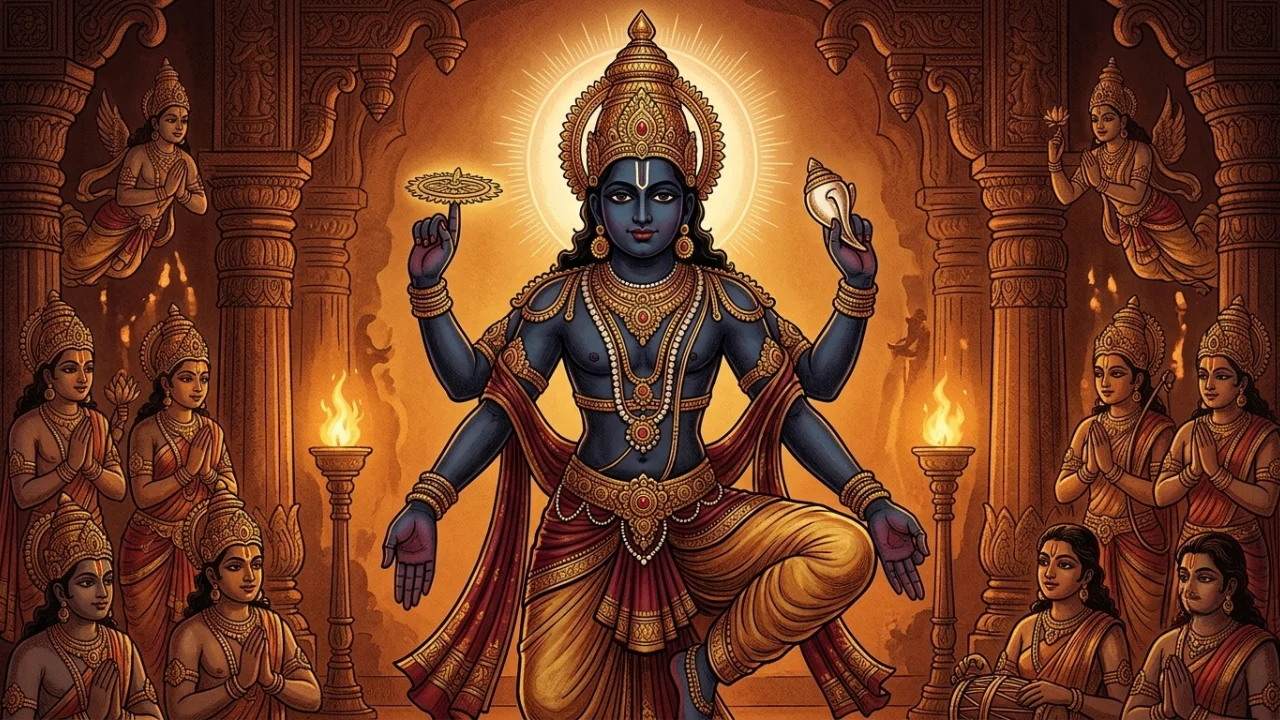
- Narayana, Nara and Vasuki are dark blue, a detail that has stayed remarkably alive in performance tradition. Krishna’s blue-black complexion in Bharatanatyam and Kathakali, and the deep blue used for Vishnu across Indian temple sculpture, both trace back to this exact line.
Demigods and adversarial beings sit at the darker end of the palette.

- Daityas, Danavas, Rakshasas, Guhyakas, the Pishachas, Yama and even the sky itself are dark blue.
- Yakshas, Gandharvas, Bhutas, Pannagas (Nagas), Vidyadharas, Pitrs and monkeys are described as “of various colours,” which is Sage Bharata’s way of saying this category does not reduce to one rule; a director had latitude here that he did not grant elsewhere.


Humans, by continent and region
People of the Six Continents are painted burnished gold. Within Jambudvipa, where people of many colours actually live, everyone except the inhabitants of the North Kuru region is given gold too, an interesting override that treats gold as something close to a default human colour in the cosmology.
Bhadrashva gets white; Ketumala gets blue; the remaining subcontinents get reddish yellow (gaura). Bhutas and dwarfs are treated separately again, described as multiple character colours and given animal-adjacent faces such as boar, ram, buffalo or deer, which tells you this category was meant for grotesque or comic stage figures rather than realistic human portrayal.

Bharatavarsha: kings, commoners, sages and labourers
Kings are lotus-coloured, dark blue, or reddish yellow, a set of three options rather than one fixed rule, likely because a play needs to distinguish between multiple royal characters on stage at once.
Ordinary happy people are reddish yellow (gaura). People engaged in “vile acts,” those described as possessed, diseased, doing penance, doing laborious work, or of lower birth, are brown (a-sita). Sages are given the colour of plum (vadara), and those specifically observing austerities (tapas) are brown as well.
Bharata muni then adds a caveat that is easy to miss but matters enormously for how you should use any of this: colour “may be varied according to habitation, birth and age,” and according to the director’s own judgement, once the place, time and character are understood.
It is closer to a starting palette that a competent production adjusts to context, the same way a lighting designer today starts from a colour temperature guide and then adjusts for the specific room.
Groups, regions and castes named directly
The text goes further still, naming specific peoples. Kiratas, Barbaras, Andhras, Dramilas, Kashis, Kosalas, Pulindas and southern peoples are mostly brown. Shakas, Yavanas, Pahlavas and Vahlikas, all northern peoples in Bharata’s geography, are reddish yellow. Panchalas, Surasenas, Odras, Magadhas, Angas, Vangas and Kalingas are dark blue. Brahmins and Kshatriyas are reddish yellow; Vaishyas and Shudras are dark blue.

I want to be direct about what this section is and is not. It is a documented convention from a roughly two-thousand-year-old dramaturgical text, describing how stage colour once mapped onto real social categories in the world Bharata knew. It is not a design brief for anyone staging a theatre today.
Most serious contemporary artists and schools read this passage the way they read the caste-linked seating rules elsewhere in the treatise: as historical record worth understanding, not as instruction to reproduce. Kathakali’s own evolution is the clearest proof this happened already within tradition. Its colour code abstracted real ethnicity and caste out of the system entirely and rebuilt it around moral and narrative category instead: paccha (green) for noble heroes, katti (bold red and white patterns) for morally mixed antagonists, thaadi variants for different registers of the demonic, kari for the truly malevolent.

How to actually use this if you are staging or choreographing
- Start with category, not colour. Is the character divine, demonic, human, or a hybrid stage type such as a Bhuta?
- Check for a named exception. Sage Bharata carves out specific deities (Rudra, Brahma, Skanda, the Sun) and specific beings (Narayana, Vasuki) from their general category colour. Always check whether your character is one of the named exceptions before defaulting to the group rule.
- Layer conduct over category for human roles. A king is not automatically reddish yellow; his moral register, whether the play frames him as virtuous, tormented or corrupt, pulls from the lotus, blue or gaura options Bharata muni offers.
- Decide, deliberately, how you are handling the region and caste layer. If you are working from the shastra closely, name this choice in your programme notes or director’s statement rather than letting it pass silently. Audiences notice omission more than adaptation when it is explained.
- Build the final colour from Bharata’s primaries. The treatise describes derivative shades built from four base colours, so a “lotus” or “bluish white” is a specific mixture the text defines, which is worth reading alongside the site’s broader makeup guide covering the four facial colours for how colour and emotion interact once the base is set.
- Coordinate with alamkara and pusta. Colour does not perform alone. A gold-painted deity in modest ornament reads differently than the same colour paired with a full āropya necklace set and a pralambita garland. The nepathya breakdown of ornament and costume categories is the natural next read for getting that layering right.
A short worked example
Take a scene with three figures: Vishnu descending as an avatar, a Rakshasa antagonist, and a righteous king caught between them.
Vishnu takes the dark blue assigned to Narayana specifically, distinct from the general reddish-yellow given to gods as a class.
The Rakshasa takes the dark blue given to demonic beings as a category, a genuinely interesting overlap the text does not resolve for you; in practice, ornament and mask carry the differentiating weight here, since colour alone cannot separate hero from antagonist when both fall under the same base shade.
The king, if written as virtuous, can reasonably take gaura; if the play frames him as morally compromised, dark blue or lotus becomes the more defensible reading. None of this is arbitrary once you trace it back to the text, and none of it requires guessing.
Related articles
Frequently asked questions
It’s “painting the limbs,” one of four branches of nepathya, the section governing costume and make-up colour.
The Natyashastra assigns Narayana and Vasuki a specific dark blue, distinct from the general gold used for gods, and that detail survived into later performance traditions.
Rarely as literal instructions. Most schools, following Kathakali’s own precedent, keep the moral-legibility logic but drop the ethnic and caste mapping.
Black, blue, yellow and red. Every other shade in the system, including lotus and bluish-white, is derived from mixing these four.
Mukharāga is facial colour tied to emotion in the moment. Varna vidhana is the base body colour tied to a character’s nature, birth and origin.
Share the article
Final thoughts
What strikes me most about this chapter is how little it trusts to instinct. Bharata muni is not writing poetry about colour symbolism. He is building a working system precise enough that a make-up artist in one city and a make-up artist in another, centuries apart, could paint the same character and produce a recognisable result.
That is a remarkable ambition for a text this old, and it is also exactly why the caste and regional layer needs honest handling rather than either silent omission or unreflective reproduction. Read the system for what it teaches about legibility, category and exception, adapt the parts that no longer belong on a modern stage, and you end up with something Bharata muni would likely recognise as faithful to his actual goal: an audience that knows who they are watching before a single word is spoken.
About Natya-Shastra.in
At Natya-Shastra.in, our mission is to serve as a gateway to the illustrious world of the Natyashastra. We offer insights, resources, and a platform to delve deeper into the nuances of Indian performing arts.
Also, we aim to bring forth the richness of this ancient text. We try to shed light on the profound wisdom it holds and its everlasting influence on various artistic traditions.
We are here, follow us.
Disclaimer:
Affiliate Links: Some links earn us a commission (at no cost to you). We only recommend helpful products.
NatyaShastra Glossary: Head over to the Natyashastra Glossary page to know the meaning behind Sanskrit terms used in the articles.
Images & Videos: Representational only, not exact depictions.
Knowledge Source & References: Inspired by ancient Natyashastra scriptures, open to interpretation.

Offer Your Expertise