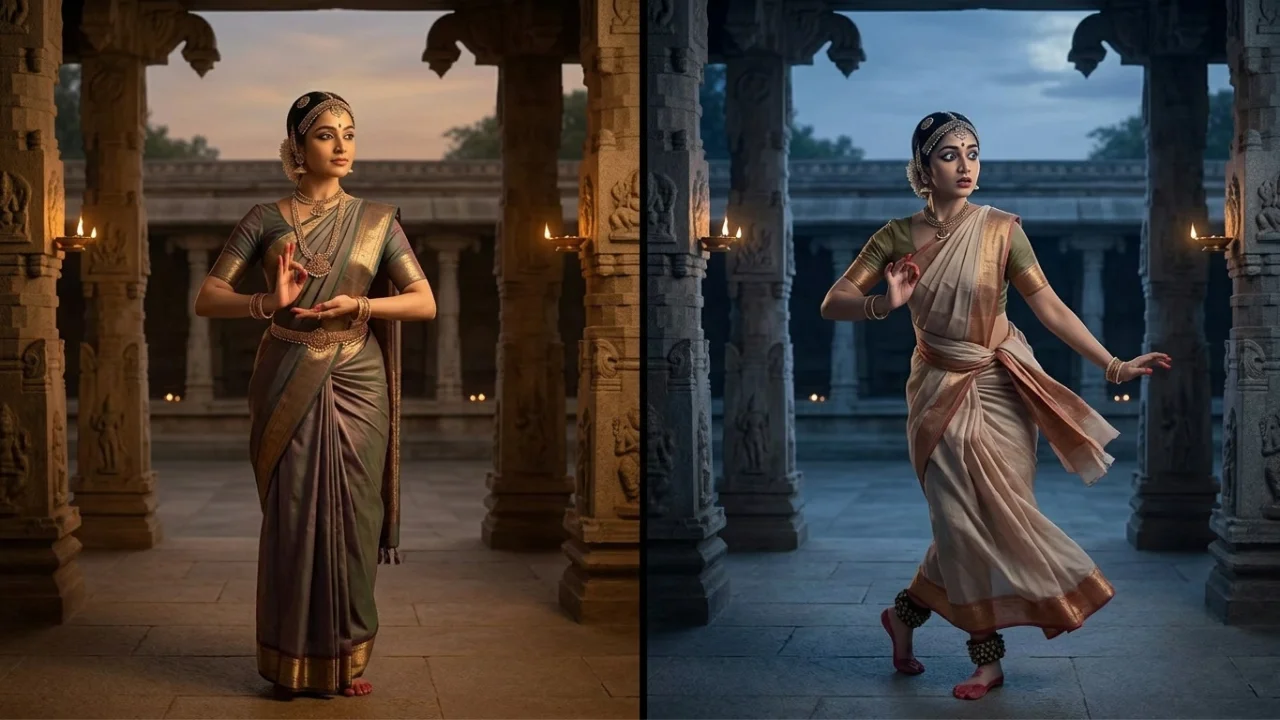
Bharata muni’s discussion of stri prakriti in the Natyashastra sets up one of the most detailed character-typing systems. Twenty temperaments, each borrowed from a god, a mythic being, or an animal, each with its own walk, its own temper, its own way of loving and fighting.
If you dance Bharatanatyam, Odissi, Kathak, or any Natya-rooted form and you’ve ever struggled to make a nayika feel like a distinct person rather than a generic “heroine,” this article is where the missing piece lives.
I want to walk you through what stri prakriti is, and how a performer turns a two-line description into an active stage presence.

We are here, follow us.
What is stri prakriti?
Stri prakriti means “the nature of a woman.” In Natyashastra, Bharata muni sets out twenty distinct temperaments that a woman (in the dramatic sense, a female role) might embody. He borrows the vocabulary from four categories: divine beings (goddess, Gandharva, Yaksha), demonic or semi-divine beings (Asura, Rakshasa, Naga, Pishacha), humans, and animals (tiger, monkey, elephant, deer, fish, camel, makara, horse, buffalo, goat, dog, cow, ass, swine, and birds).
Each type gets a short but specific description covering physical build, temperament, sexual disposition, food preferences, and social habits. A woman of the Gandharva type loves gardens, has a slow graceful gait, and delights in music. A woman of the Rakshasa type has broad limbs, red eyes, a loud voice, and a temper that flares fast. Also, a woman of the deer type is fickle, easily startled, and drawn to song. None of this is meant as a literal claim about real women. It’s a casting shorthand, a set of archetypes an actor and director could use to quickly communicate what kind of energy a role needs.
It’s worth being upfront about something here. Read outside its context, this chapter can sound like it’s making blunt claims about female character. Read as dramaturgy, which is what it is, it functions closer to the way a modern acting coach might say “play her as a tiger, not a kitten.” The value for a performer is in the specificity it forces on you.
This is different from Samanyabhinaya, which is about the universal grammar of expression every performer uses regardless of role. Stri prakriti is about typing one particular kind of character before you apply that grammar to her.
The twenty prakritis
Trying to memorise all twenty like a list rarely sticks onto our memory. So, grouping them by the quality they’re built around makes them far easier to internalise and cast against a role.

Refined and graceful:
- Goddess (delicate, calm-eyed, gentle in appetite and habit)
- Gandharva (music-loving, soft-skinned, slow and elegant in gait)
- Human (upright, dutiful, warm toward friends and elders)
- Cow (patient, kind, respectful, steady under hardship).
Passionate and sensual:
- Yaksha (intelligent, fearless, deeply affectionate on reunion)
- Naga (restless, fond of company and scent, given to an oblique, swaying walk)
- Fish (large-eyed, fond of water, surrounded by many companions)
- Horse (charming, quick-tempered, strongly passionate).
Fierce and untamed:
- Rakshasa (loud, quarrelsome, active at night)
- Tiger (proud, indifferent to honour or shame, blunt in speech)
- Buffalo (broad-framed, combative, drawn to water and forest)
- Asura (deceptive, quick to anger, fond of excess).
Restless and quick:
- Monkey (small, energetic, impulsive, drawn to trees and gardens)
- Deer (timid, quick-moving, easily startled, musical)
- Goat (delicate, shy, skittish)
- Bird type (large-mouthed, talkative, fickle, fond of open air).
Heavy and grounded:
- Elephant (large-framed, steady, fond of water and rich living)
- Swine (broad, plain-featured, drawn to roots and modest fare)
- Camel (protruding lips, awkward gait, sharp of tongue)
- Makara (broad-headed, loud, blunt)
- Ass (rough of skin and speech, stubborn, unshaken by jealousy).
Unusual and eerie:
- Pishacha (irregular features, unsettling manner, drawn to fields and gardens at odd hours).
- Take a look


Bharata Muni's Natyashastra: A Treatise On Ancient Indian Dramaturgy And Histrionics
An authoritative two-volume edition of the classical Natyashastra, the foundational Sanskrit treatise on drama, dance, music, and performance attributed to sage Bharata Muni. Perfect for serious learners, researchers, and lovers of Indian arts. - Take a look

Nandikeshwar's Abhinaya Darpanam, Revised & Enlarged
A classic treatise on Indian dance and performance, this revised edition of Abhinaya Darpanam.- Authoritative guide on classical dance gestures and expressions.
- Based on an ancient Sanskrit text by Nandikeshwar, with translation and notes.
- Helpful for understanding angika and expressive principles.
How to actually perform a prakriti on stage
Naming the type is step one. Building it into a performance is where the real craft sits, and it happens through four connected choices.
1. Start with the gait
Bharata muni’s system of walks gives you the fastest way into a temperament. A deer-natured woman moves quickly and lightly, prone to sudden stops. A buffalo-natured woman plants her steps and moves with weight. If you haven’t worked through the walking postures of women in the Natyashastra, that’s the natural next stop after this article.
2. Layer in the glance
The eyes carry temperament almost as strongly as the gait does. A goddess-type role calls for a steady, unhurried gaze. A tiger-type role wants sharper, more direct eye contact, held a beat longer than comfortable. Bharata muni catalogues thirty-six distinct glances for exactly this kind of fine-tuning, and matching glance to prakriti is where a performance stops looking generic.
3. Choose your rasa carefully
Prakriti and rasa aren’t the same thing, but they interact constantly. A Gandharva-natured heroine in a shringara-heavy scene will look very differently from a Rakshasa-natured one placed in the same scene. Understanding how shringara rasa shifts across the nine rasas gives you the emotional register; prakriti gives you the personality wearing that register.
4. Let costume and colour finish the picture
Bharata muni’s guidance on character colours and costume gives you a visual shorthand that reinforces prakriti. A fierce, Rakshasa-natured role sits naturally in stronger, more saturated colour and sharper ornamentation than a soft, deer-natured one.
Here is an example: two nayikas, two prakritis
Take a single narrative moment, a woman waiting for a lover who is late, and run it through two different prakritis to see how much the choice changes.
Played with goddess prakriti, she waits with composure. Her gait stays measured, her glance is calm rather than anxious, and any distress she shows surfaces through restrained sattvika bhava rather than visible agitation. The audience will see this as patience and quiet dignity.
Played with deer prakriti, the same wait becomes restless. She startles at small sounds, her gait quickens and stops unpredictably, her glances dart toward the entrance. The same narrative beat, the same words if there’s dialogue, but an entirely different emotional colour because the underlying temperament is different.
That contrast is the whole point of learning this chapter. It gives a choreographer or soloist a fast, shared vocabulary for deciding how a character should feel before the choreography even begins.
Related articles
Frequently asked questions
Stri prakriti is Bharata muni’s system of twenty character temperaments for female roles, described in Natyashastra. Each type borrows traits from a deity, a mythic being, or an animal, giving performers a shorthand for building a character’s walk, temper, and emotional range.
Twenty. They fall into four broad groups: divine and semi-divine beings, demonic or eerie beings, one human type, and a large set of animal types including tiger, deer, elephant, and horse.
Samanyabhinaya is the universal grammar of expressive acting that applies to every performer and every role. Stri prakriti is a narrower casting tool used specifically to type female characters before that grammar gets applied.
Not as a formal syllabus item in most schools, but experienced teachers and choreographers apply its logic informally when shaping a nayika’s gait, glance, and temperament for a specific piece.
No. It was written as a dramaturgical device for casting and characterisation in court drama, not as commentary on actual female nature. Modern readers get the most value treating it as an archetype system, similar to an actor’s character study.
Share the article
Final thoughts
Stri prakriti rewards patience. The twenty types look, at first glance, like a rigid taxonomy to memorise and move past. Spend real rehearsal time with even three or four of them, though, and you’ll notice your characterisation choices get sharper across the board, not just for the roles you consciously typed this way. That’s the mark of a good classical framework. It changes how you see every role, not just the one you were working on.
If you’re building this into your practice, pair it with the glossary of Natyashastra terms so the Sanskrit vocabulary stays precise, and revisit Samanyabhinaya alongside it, since the two chapters were always meant to work together.
References
About Natya-Shastra.in
At Natya-Shastra.in, our mission is to serve as a gateway to the illustrious world of the Natyashastra. We offer insights, resources, and a platform to delve deeper into the nuances of Indian performing arts.
Also, we aim to bring forth the richness of this ancient text. We try to shed light on the profound wisdom it holds and its everlasting influence on various artistic traditions.
We are here, follow us.
Disclaimer:
Affiliate Links: Some links earn us a commission (at no cost to you). We only recommend helpful products.
NatyaShastra Glossary: Head over to the Natyashastra Glossary page to know the meaning behind Sanskrit terms used in the articles.
Images & Videos: Representational only, not exact depictions.
Knowledge Source & References: Inspired by ancient Natyashastra scriptures, open to interpretation.

Offer Your Expertise