Estimated reading time: 0 minutes
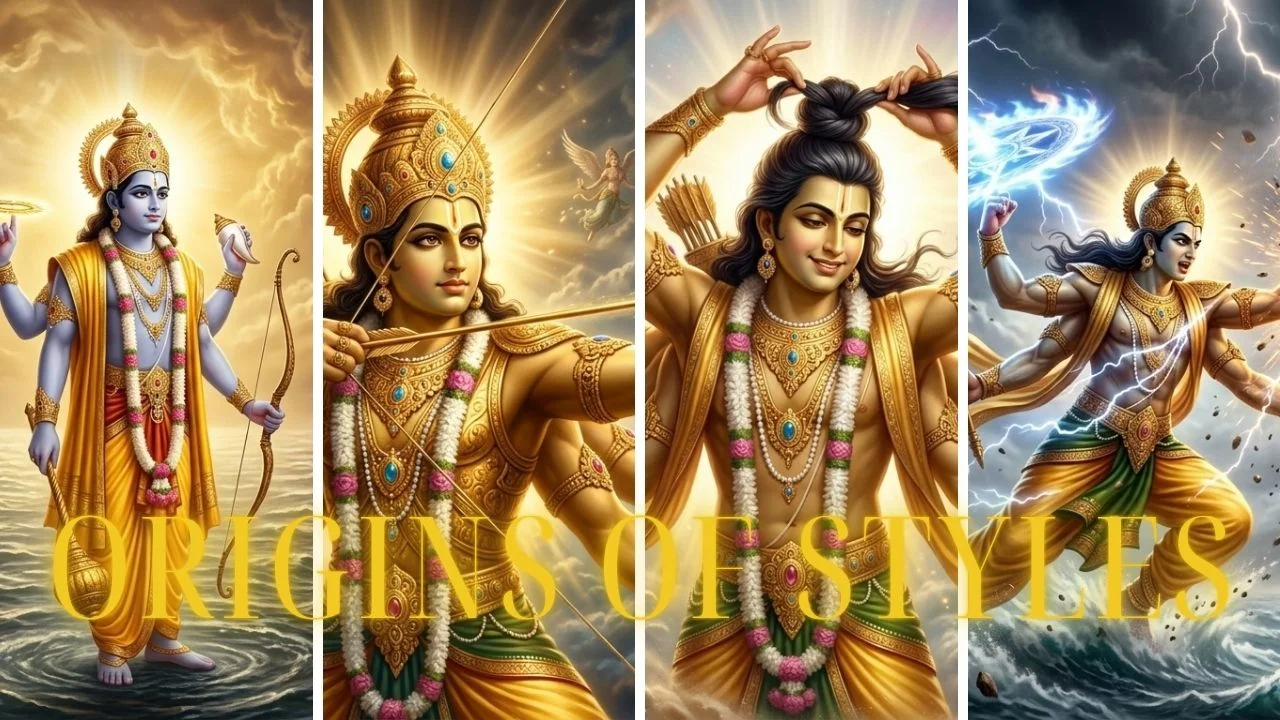
The origin of styles, or vrittis, traces back to a primordial battle between Vishnu and the Asuras Madhu and Kaiṭabha. From that clash emerged the four foundational performance styles that still shape Indian classical theatre today.
Bharata Muni did not invent these vrittis. He witnessed their mythic origins and noted them.

We are here, follow us.
What are the four vrittis?
The word vṛtti in performance context refers to the dominant quality or expressive mode that colours an entire dramatic register.

- Bhāratī (Bhaaratii) vritti – the Verbal Style
- Sāttvatī (Saattvatii) vritti – the Grand Style
- Kaiśikī (Kaishikii) vritti – the Graceful Style
- Ārabhaṭī (Aarabhatii) vritti – the Energetic Style
Each emerged from a specific quality of Vishnu’s action during the battle. This is Bharata’s way of anchoring each vritti in a fundamental human energy, cosmic in scale but practical in application. To understand the origin of styles is to understand what each vritti is actually made of.
The cosmic battle as a performance text
Before examining each vritti individually, it helps to hold the full scene in mind. Vishnu lies on the cosmic ocean, resting on the serpent Śeṣa, having compressed the entire universe into a dormant seed. Madhu and Kaiṭabha, two Asuras drunk on pride, decide this is the moment to challenge him. They taunt him, rub their arms in the warrior’s gesture of defiance. They fight with fists and knees. And they hurl abusive words so loud that the ocean itself seems to tremble.

Brahmā watches all of this. He recognises the scene for what it is: a complete dramatic event already unfolding before any drama has been formally composed. Each distinct quality of that event becomes, in his understanding, the seed of a different vritti.
This is a beautiful structural insight. Drama does not imitate life abstractly. It isolates, names, and amplifies the specific energies that are already present in cosmic experience.
Origin of the Verbal Style (bhāratī vritti)
When Madhu and Kaiṭabha begin to hurl abusive words at Vishnu, Brahmā recognises something. He says to Vishnu, in effect: is this not the bhāratī vṛtti beginning right here, with these very words, growing louder with each exchange?
Vishnu confirms it. He says the bhāratī vṛtti belongs to the speaker and is built on the preponderance of words (vāgbahulā). The style arises from the weight of language itself.

What this means in practice
The name bhāratī is linked etymologically to the earth (bhūmi) and to the burden (bhāra) that Vishnu’s forceful footwork placed upon the ground. There is something deeply physical about this “verbal” style. The weight of the spoken word, the stamp of the foot, the pressure of rhetoric. Bhāratī vritti is not gentle speech. It carries force.
In classical Bharatanatyam and Kuchipudi performance, bhāratī vṛtti appears in sequences where nāyaka characters deliver long verbal challenges, argue in sabhās (assemblies), or recite ślokas with rhetorical weight. The Sūtradhāra’s opening speech in theatre (the pūrvaraṅga) draws heavily from this style. So do the pada abhinaya passages where the sakhī debates or negotiates on behalf of the nāyikā.
Practical note for performers: Bhāratī vṛtti demands that words carry their own weight. The abhinaya should not race ahead of the syllable. Think of Vishnu’s footwork pressing into the earth. Let the text press into the audience the same way.
Origin of the Grand Style (sāttvatī vṛtti)
This one emerges from the rebound of Vishnu’s bow, Śārṅga. Bharata describes it as arising from intense brilliance, steadiness, and an excess of unperturbed sattva (which here means inner strength or essence, not the sattva of the triguna system, though the resonance is deliberate).
The sāttvatī vṛtti is the Grand Style. It is aligned with the heroic and the divine. It is associated with śṛṅgāra (love/beauty) and vīra (heroism) rasas.

What this means in practice
The bow rebounds. That moment – tight, suspended, full of compressed energy releasing outward – that is sāttvatī. Don’t think of it as explosiveness. It is controlled, radiant power. Think of it as the quality of a performer who commands the space without straining.
In Odissi and Manipuri performance, sāttvatī vṛtti surfaces in the tribhangi posture sequences dedicated to Kṛṣṇa, where elegance and divine authority coexist. In Kathakali, the pacha (green) characters embody this style. The composure is the power.
Practical note: Sāttvatī demands sattva in the performer’s own body. Unperturbed presence. Any trembling of attention, any reaching for effect, dilutes the style immediately. This is why many mentors train the body to stillness before they teach it to move expressively. The still bow holds the most power.
Origin of the Graceful Style (kaiśikī vṛtti)
Here the origin becomes unexpectedly intimate. Mid-battle, Vishnu pauses to move sportively, with various aṅgahāras (composite movement units), and ties up the knot of his hair, his śikhā. From that graceful, self-possessed gesture in the midst of combat, the kaiśikī vṛtti is born.
Kaiśika comes from keśa, hair. It is the style of softness, of beauty, of the feminine aesthetic principle operating within the world.

What this means in practice
The kaiśikī vṛtti is most explicitly associated with śṛṅgāra rasa. It uses elaborate costuming, music, song, dance, and tender gesture (lalita hāva). It is the style that carries love, longing, feminine beauty, and the lyrical. The Natyashastra directly links kaiśikī to women characters and to the erotic and comic rasas.
But the origin of styles story complicates any simplistic reading. Vishnu performs this graceful gesture in the middle of a deadly battle. Kaiśikī is not fragility. It is beauty that knows its own strength. A seasoned performer of this style does not become soft. She becomes precise in a different register.
In Bharatanatyam, the padavarnam sequences exploring śṛṅgāra, particularly viraha (longing in separation), draw from kaiśikī vṛtti. So do the aṣṭapadī performances in Odissi, Kuchipudi, and Manipuri traditions. The entire Jayadeva Gītagovinda performance aesthetic is saturated in kaiśikī.
For more on how vṛttis shape expressive performance in the larger theatrical system, see Vrittis in Natyashastra: The Art of Expressive Performance.
Practical note: Many younger performers confuse kaiśikī with sweetness. It is not sweet. Each gesture in this style must carry the exact emotion at the exact moment. Softness without precision is formlessness, not kaiśikī.
Origin of the Energetic Style (ārabhaṭī vṛtti)
The last vṛtti emerges from the combat itself in its most intense phase. The various personal combats fuelled with energy, excitement, multiple cārīs (movement units involving footwork and jumps), generate the ārabhaṭī vṛtti.
Ārabhaṭī is associated with raudra (fury), vīra (heroism), and bībhatsa (disgust) rasas. It carries the energy of confrontation, exaggeration, supernatural feats, and extreme action.

What this means in practice
Ārabhaṭī vṛtti has a specific quality: it amplifies reality toward the superhuman. The cārīs that generate it are the leaps, bounds, spinning falls, and aerial manoeuvres of warriors who exceed human limit.
In Kathakali, the kari and pazhuppu (black and red-bearded) characters express ārabhaṭī consistently. Their exaggerated gestures, stamping footwork, and roaring vocalisation are not histrionics. They are precisely calibrated expressions of this style. In Chhau dance, especially Seraikella and Purulia Chhau, ārabhaṭī vṛtti pervades the martial sequences representing battles from the Mahābhārata.
For performers of Yakṣagāna in coastal Karnataka, this style defines much of the repertoire. The tāḷamaddale (verbal performance) sequences of heroic characters operate entirely within ārabhaṭī.
Practical note: Ārabhaṭī is the most frequently distorted vṛtti in contemporary performance. Performers mistake loudness for energy, or speed for power. The origin story points to cārīs as the root. The style lives in the quality of footwork and the exactness of physical attack. Uncontrolled aggression is not ārabhaṭī.


Brahmā as the first spectator and theorist to origin of styles
This is Bharata’s quiet argument about the role of the theorist, the mentor, the dramaturge. The origin of styles (vṛttis) did not need Brahmā to exist. They arose spontaneously from Vishnu’s action. But they needed Brahmā to recognise them, name them, and connect them to words and meaning.
This is still the work of a teacher today. The expert does not create the student’s natural movement quality. She identifies it, names it, and shows the student how to refine and deploy it consciously.
How the four vrittis relate to regional variations
The Natyashastra does not treat the vṛttis as purely abstract categories. They connect to regional performance traditions through the concept of pravṛtti. Bharata describes four regional styles, Āvantī, Dakṣiṇātya, Oḍhramāgadhī, and Pāñcālī, each of which tends toward certain vṛttis.
To explore how these regional dimensions shape performance, see Pravṛttis in Natyashastra: Bharata’s Regional Variations.
Working with origin of styles (vrittis) in training
Here is what a practitioner can actually do with this knowledge.
Identify the dominant vṛtti of each composition. Before staging any piece, ask which vṛtti governs it. A daśāvatāra composition where Narasimha tears open Hiranyakashipu will require ārabhaṭī. A padam expressing viraha will require kaiśikī. Many compositions are not mono-vṛtti, and the transitions between styles create much of the expressive richness.
Train each vṛtti separately before mixing them. The cārīs of ārabhaṭī are not the same as the soft limb movements of kaiśikī. Trying to perform them simultaneously without having drilled each one isolates you in a muddle. Separate the strands first.
Use the mythic imagery as a physical anchor. The rebounding bow of Śārṅga is a concrete physical image for sāttvatī. Use it in rehearsal. The śikhā-tying gesture for kaiśikī is specific and intimate.
Study the rasas mapped to each vṛtti. The Natyashastra links vṛttis to specific rasas at multiple points in the text. Bhāratī can carry most rasas but is especially suited to verbal comedy (hāsya) and heroic declamation. Sāttvatī carries śṛṅgāra and vīra with dignity. Kaiśikī saturates the romantic and lyrical. Ārabhaṭī drives raudra, vīra in its fierce register, and bībhatsa. Knowing these associations prevents category errors in abhinaya.
References
- Bharata Muni. Nāṭyaśāstra
- Nandikeshvara. Abhinayadarpaṇa
- Dasarupa of Dhananjaya
- Tripathi, R. (ed.). Nāṭyaśāstra in the Modern World: Proceedings of the 15th World Sanskrit Conference.
- Tarlekar, G. H. Studies in the Nāṭyaśāstra.
Frequently Asked Questions
The four vrittis originate from a mythic battle between Vishnu and the Asuras Madhu and Kaiṭabha, as described in Natyashastra. Each vṛtti arose from a distinct quality of Vishnu’s action, his speech, the rebound of his bow, a graceful hair-tying gesture, and the ferocity of combat. Brahmā observed and named them.
Bharata Muni identifies bhāratī (Verbal Style), sāttvatī (Grand Style), kaiśikī (Graceful Style), and ārabhaṭī (Energetic Style). Each corresponds to a dominant expressive register and is associated with specific rasas and performance traditions in Indian classical dance and drama.
Kaiśikī vṛtti governs compositions centred on śṛṅgāra rasa, particularly viraha (longing in separation) padams and padam abhinaya sequences. Its defining quality is precise, lyrical gesture rather than mere softness. Jayadeva’s Gītagovinda performances draw deeply from this style across multiple Indian classical forms.
Sāttvatī vṛtti expresses controlled, radiant inner strength, rooted in the rebound of Viṣṇu’s bow and associated with composed heroism and divine grace. Ārabhaṭī vṛtti is energetic and combative, rooted in the ferocity of battle and expressed through vigorous cārīs, stamping, and exaggerated movement associated with raudra and vīra rasas.
In the Natyashastra narrative, Brahmā functions as the first spectator and theorist. The vṛttis arose naturally from Vishnu’s action, but required an observer to recognise, name, and connect them to meaning. This mirrors the role of the mentor in classical performance training, not creating the student’s natural expressive quality, but identifying and refining it.
Related articles
Final thoughts
The origin of styles in the Natyashastra is one of those passages that rewards re-reading at every stage of a performer’s career. Early on, it reads like myth. Later, it reads like a map. Eventually, if you have spent enough time in training and performance, it reads like a description of something you already know in your body but have not yet named.
Bhāratī is the weight of the word. Sāttvatī is the rebound of steady strength. Kaiśikī is grace that knows its power. Ārabhaṭī is energy shaped into ferocity. Brahmā did not invent these qualities. He recognised them in action and gave them names.
That recognition is still available to every practitioner who watches carefully, trains honestly, and reads the text not as scripture but as an extraordinarily precise manual of human expressiveness.
About Natya-Shastra.in
At Natya-Shastra.in, our mission is to serve as a gateway to the illustrious world of the Natyashastra. We offer insights, resources, and a platform to delve deeper into the nuances of Indian performing arts.
Also, we aim to bring forth the richness of this ancient text. We try to shed light on the profound wisdom it holds and its everlasting influence on various artistic traditions.
We are here, follow us.
Disclaimer:
Affiliate Links: Some links earn us a commission (at no cost to you). We only recommend helpful products.
NatyaShastra Glossary: Head over to the Natyashastra Glossary page to know the meaning behind Sanskrit terms used in the articles.
Images & Videos: Representational only, not exact depictions.
Knowledge Source & References: Inspired by ancient Natyashastra scriptures, open to interpretation.

Offer Your Expertise